
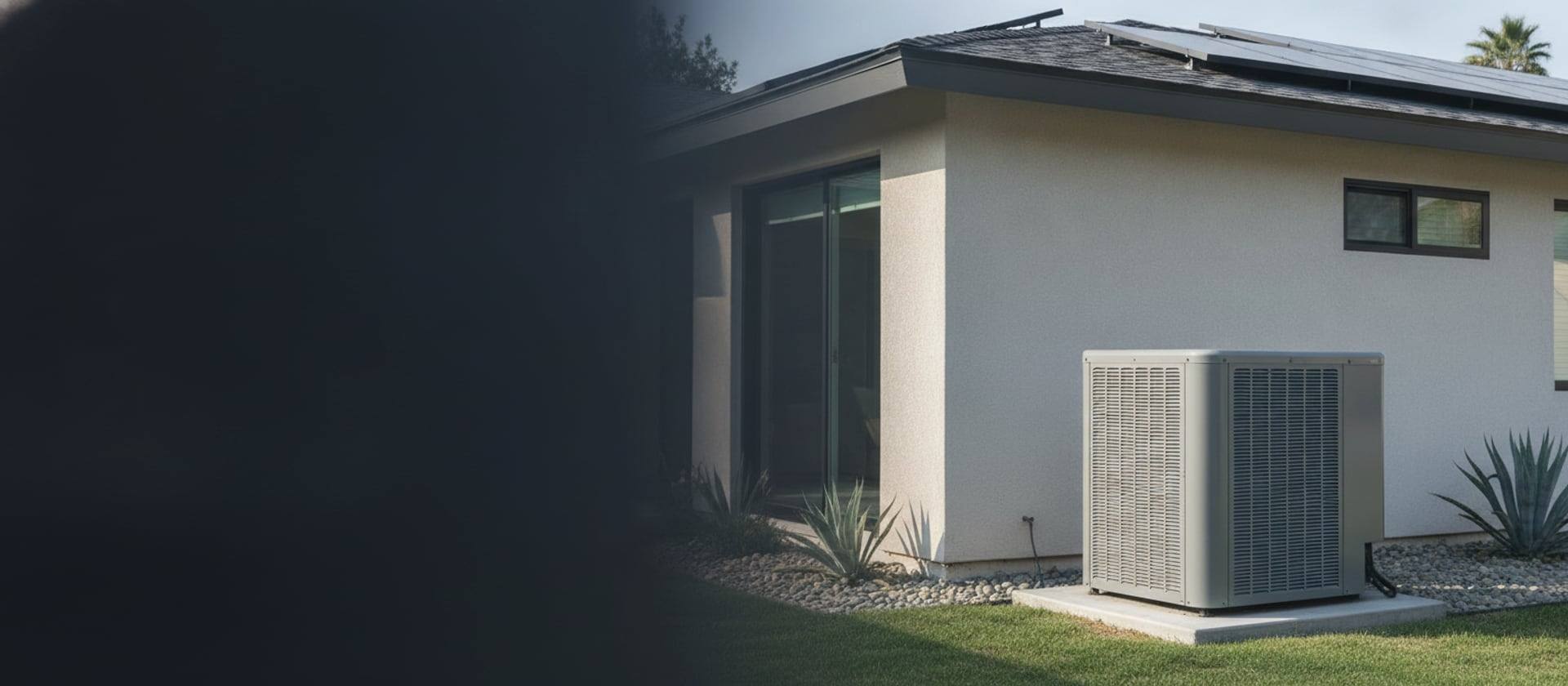
Converting from gas furnace to heat pump in California 2026 typically costs $14,500–$22,000 installed, before rebates. LADWP territory homeowners net $9,000–$15,000 after $1,250–$2,500/ton rebates. Federal IRA Section 25C tax credit expired December 31, 2025 under OBBBA — utility rebates are now the main lever. Most installs take 1–2 days on site.
California is electrifying. The state’s 2045 carbon-neutral target means new gas appliance restrictions are rolling through cities (Berkeley, Oakland, Los Altos, San Francisco have banned natural gas in new construction). Beyond regulation, the 2026 economics genuinely favor electrification for SoCal homeowners — LADWP heat pump rebates increased to $2,500/ton in late 2025, and the federal credits expiring shifted the rebate stack toward utilities. We do gas-to-heat-pump conversions every week. This post covers what the conversion actually involves, what it costs, what we look for during the in-home estimate, and the cases where conversion makes sense vs. where keeping gas is still the right call. CSLB #1138898 (C-20). TECH Clean California certified.
What conversion actually means — the technical scope
The work that goes into a real conversion, in order:
- Decommission existing gas furnace. Shut off gas supply at the furnace shut-off valve. Disconnect supply line. Cap the gas line at the furnace (the supply line stays in the wall for now). The line can be capped at the meter later for full removal, or kept capped at the furnace if you have other gas appliances (water heater, range, dryer) on the same supply.
- Remove the gas furnace from the closet or attic platform. Disconnect flue venting (B-vent typically goes up through the roof and gets sealed off — we cap the roof penetration to prevent leaks). Remove furnace, recycle to scrap.
- Install matched heat pump system: outdoor condenser unit on a side-yard pad or rooftop bracket; indoor air handler in the existing furnace closet, or a multi-zone ductless system with wall heads and side-yard outdoor multi-port unit.
- Use existing ductwork if salvageable, replace if not. Ducts get inspected for leakage and condition; if leakage is over 15–20%, we recommend Aeroseal duct sealing ($1,500–$2,500 add-on) or duct replacement ($3,000–$7,000) depending on severity.
- Electrical work: heat pump requires a dedicated 240V circuit at 30–50A. Panel capacity check; service upgrade if needed.
- New refrigerant lineset typically required — old AC linesets often do not match the new heat pump tonnage or the A2L refrigerant requirements. Linesets pulled to 500-micron vacuum, refrigerant charged to manufacturer subcool/superheat target.
- Condensate handling: heat pumps produce condensate year-round (winter heating mode produces condensate from the outdoor coil during defrost; summer cooling mode produces condensate from the indoor coil). Drain plumbing matters — condensate float switch on the indoor unit prevents water damage if drain clogs.
- Permit and HERS testing required by California Title 24 on any HVAC change-out. We pull the permit in your name; HERS rater scheduled within 30 days post-install.
What it costs in 2026 (LA market)
Real installed pricing by configuration:
- 3-ton ducted heat pump conversion: $14,500–$18,500
- 4-ton ducted heat pump conversion: $17,000–$22,000
- 5-ton ducted heat pump conversion: $19,500–$24,000
- Multi-zone ductless conversion (3-zone, no existing ducts): $13,500–$18,500
- Multi-zone ductless conversion (4–5 zone): $16,500–$22,000+
Common add-ons that surface during the in-home estimate:
- Electrical panel upgrade (100A → 200A): $2,500–$4,500
- Ductwork replacement (worst-case leakage or asbestos): $3,000–$7,000
- Aeroseal duct sealing: $1,500–$2,500 (often pays for itself in efficiency over 5 years)
- Smart thermostat: $250–$450 installed (LADWP $140 rebate)
- Roof bracket for outdoor unit (where side-yard placement is not possible): $400–$800
How rebates change the math — this is the conversion driver
Active 2026 rebate stack varies sharply by utility territory:
- LADWP territory (most of City of LA, San Fernando Valley LA-city, harbor): $1,250/ton ducted heat pump rebate, $1,500–$2,500/ton ductless = $3,750–$10,000 on a 3–4 ton system. Largest active 2026 incentive in SoCal. Plus $140 LADWP smart thermostat rebate.
- SCE territory (most of OC, South Bay, SGV outside Pasadena/Burbank/Glendale, eastern LA County, most of Riverside and SB counties): TECH Clean California $3,000 standard / $4,000 moderate / up to $8,000 low-income — currently waitlisted; single-family heat pump HVAC funds were fully reserved November 14, 2025; HEEHRA fully reserved February 24, 2026. New TECH reservations go on a waitlist with no committed reopen date. Plus SCE residential rebates $300–$1,200 depending on HSPF2.
- IID territory (Indio, Coachella Valley): IID has its own residential rebate programs separate from SCE/TECH. Verify amounts directly with IID.
- RPU territory (City of Riverside): RPU residential rebates available; SCE/TECH do not apply.
- AVCE/Liberty (Apple Valley): CCA model (Apple Valley Choice Energy delivered by Liberty Utilities CalPeco, with SCE opt-out) — verify your provider on your monthly bill.
- BWP / PWP / GWP (Burbank, Pasadena, Glendale): independent municipal utilities with separate residential rebate programs.
- SoCalGas furnace-removal incentive: ~$300 when capping the gas line on a heat pump conversion. Active across the entire service area.
- Federal IRA Section 25C: terminated December 31, 2025 under OBBBA. The $2,000 heat pump tax credit is no longer available for 2026 installs.
Complete 2026 rebate breakdown by territory with submission portals and program windows.
When conversion makes sense
- Existing gas furnace 12+ years old — replacement coming anyway, conversion captures the rebate stack.
- AC also nearing replacement — replace one system instead of two, save labor cost.
- LADWP territory — the rebate stack makes the math compelling on its own.
- Rooftop solar installed or planned — electric heating maximizes solar self-consumption and ROI.
- Pre-WW2 homes without ductwork — ductless multi-zone heat pump (Mitsubishi MXZ-3C30NAHZ2) is the install path anyway, and there is no advantage to keeping the old gas system.
- Future-proofing for California gas appliance restrictions — regulatory tailwind, particularly for resale value in cities considering gas restrictions on the existing-building side.
When conversion doesn't make sense (be honest)
- Furnace under 7 years old in good condition — wasteful to remove functional equipment. Even with rebates, the math rarely works on a 5-year-old furnace.
- Apple Valley / Big Bear without cold-climate heat pump budget — standard heat pumps lose 30–45% capacity below 30°F and pull auxiliary electric heat strips that spike the bill. The right conversion in Apple Valley uses Mitsubishi Hyper-Heat or Carrier Infinity Greenspeed, which costs $2,000–$3,500 more than a standard heat pump — if that premium is not in budget, dual-fuel hybrid is a better answer than pure-electric.
- Income-qualified customers depending on HEEHRA — HEEHRA was fully reserved February 24, 2026. Do not delay an install on a failing system on the assumption that HEEHRA reopens during your project window.
- SCE territory homes where TECH funding matters and customer cannot wait for waitlist — if your cooling-load math depends on TECH rebate to make pure-electric pencil out, dual-fuel hybrid (heat pump + 99% AFUE gas furnace) often beats pure-electric heat pump on installed cost because the SoCalGas furnace rebate stacks.
- Homes with gas furnace + propane in mountains — heating economics genuinely favor gas in some Big Bear / mountain microclimates depending on propane vs. natural-gas access.
- Older homes with severe ductwork issues that would need full replacement — conversion cost can balloon by $5,000–$10,000 in duct work that nullifies the rebate advantage. Sometimes a partial-ducted approach (Mitsubishi M-PVA-A30AA7 air handler + supplemental ductless heads) is the better path.
Real conversion example (composite)
Pacific Palisades, 2,400 sq ft 1960s ranch, LADWP territory, replacing 16-year-old gas furnace + 12-year-old AC:
- Existing equipment removed (Lennox G61MP gas furnace + Lennox 13ACX outdoor AC unit)
- 4-ton Carrier Infinity 25VNA8 variable-speed heat pump installed
- Carrier FE4 air handler in existing furnace closet
- Existing ductwork sealed with Aeroseal (pre-existing 28% leakage measured, post-Aeroseal 4%)
- New refrigerant lineset (R-454B)
- 240V 50A circuit added; existing 200A panel had capacity, no service upgrade required
- City permit + HERS testing
Total cost before rebates: $20,200
- Equipment + labor: $17,500
- Aeroseal duct sealing: $2,200
- Permit + HERS: $500
Active 2026 rebate stack:
- LADWP heat pump rebate (4 tons × $1,250 ducted): −$5,000
- LADWP smart thermostat rebate: −$140
- SoCalGas furnace-removal incentive: −$300
Net out-of-pocket: $14,760
Federal IRA Section 25C ($2,000) is no longer in this math — it expired December 31, 2025 under OBBBA.
What to expect during the install (timeline)
- Day 1 morning: equipment delivery; gas furnace decommission (gas line shut off and capped at the furnace; flue venting disconnected; furnace removed and recycled).
- Day 1 afternoon – Day 2: heat pump install. Outdoor unit set on side-yard pad with vibration isolators. Indoor air handler set in the former furnace closet. Refrigerant lineset routed and brazed. Electrical circuit run from panel to outdoor unit. Aeroseal duct sealing if scheduled (4–6 hour process).
- Day 2 afternoon: system commissioning. Lineset vacuumed to 500 microns. Refrigerant charged to manufacturer subcool/superheat target. Electrical connections torqued to spec. Performance testing in both heating and cooling modes. Thermostat commissioned and paired to outdoor unit.
- Within 5–10 business days post-install: city inspection. Inspector verifies permit closure.
- Within 30 days: HERS testing. Third-party rater verifies duct leakage, refrigerant charge, and fan watt-draw.
- At job close-out: rebate documentation packet (invoice formatted to LADWP/SoCalGas requirements, AHRI Certificate Reference Number, permit final, HERS report, photos before/after). Homeowner submits LADWP rebate; we file SCE/SoCalGas/PWP/BWP/GWP as applicable.
Common conversion concerns
"Will I lose heat during install?" Yes for 4–8 hours typically, while the gas furnace is decommissioned and the heat pump is being commissioned. We schedule conversions outside cold snaps and outside winter overnights wherever possible. Total no-heat window rarely exceeds half a day.
"What about my gas water heater?" Independent system, on its own gas line tap. Not affected by central HVAC conversion. We can also do heat pump water heater conversion as a separate project — different rebate program, different scope, $3,000–$5,500 installed.
"What if I want gas back later?" The gas line can be capped at the furnace (default approach) rather than fully removed at the meter. Reconnection later is possible but requires a permit and a code-compliant reinstall. Practically: most homeowners who convert do not reverse.
"Does the heat pump replace my AC entirely?" Yes. One system handles both. The cooling side is mechanically the same as a regular AC (often higher SEER2 than a builder-grade AC), so cooling performance equals or exceeds the system being replaced.
"What about heat strips for cold mornings?" Built into the air handler as standard on most heat pump installs. Activates only when the heat pump cannot keep up with demand (typically below 30°F on standard equipment, below 5°F on cold-climate-spec'd Hyper-Heat or Greenspeed). On a properly sized install in coastal or mid-basin LA, the strips may run a handful of hours per year. On Apple Valley or Big Bear without cold-climate equipment, they run constantly — which is why we install Mitsubishi Hyper-Heat there instead.
How we install heat pumps
Heat pump electrification is what we built this business around — every install starts with a Manual J load calculation, every quote includes the AHRI Certificate Reference Number, and every customer gets a rebate documentation packet ready for LADWP submission at job close-out. TECH Clean California certified. CSLB #1138898 (C-20). Pricing, equipment, install timeline, full 2026 rebate stack: our heat pump installation page. Brand-by-brand fit: heat pump brand comparison. For service after install: heat pump repair. Cluster hub: heat pump services.
Free in-home conversion estimate: call (424) 766-1020 or email weho@ventahvac.com. Regional dispatch numbers in the footer. Side-by-side AC + furnace vs. heat pump conversion quote on every consultation.