
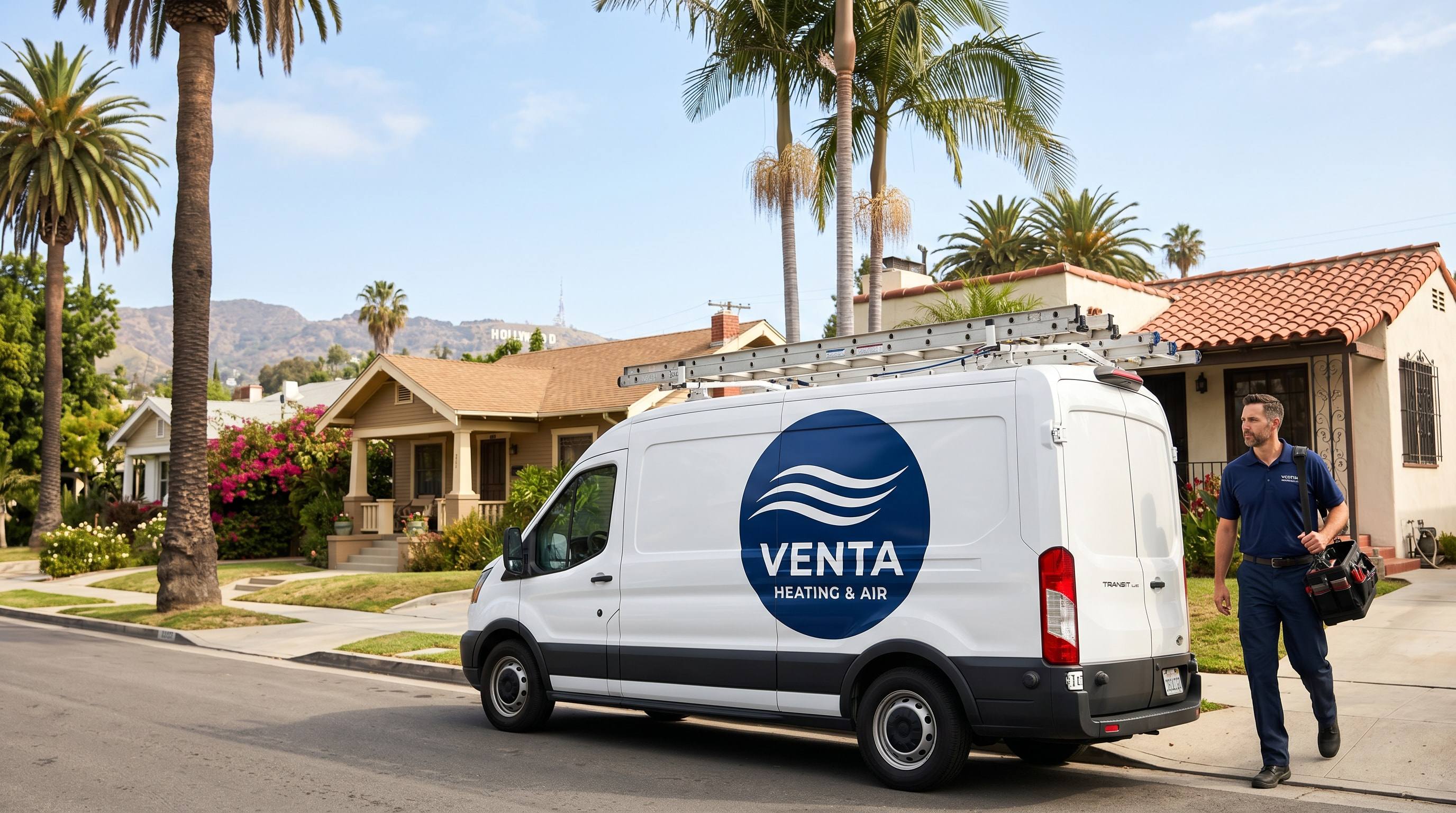
Late September last year, on a block off Carson Street near Bolivar Park. The homeowner was 79, had bought the house with her husband in 1962 when the Long Beach Navy Yard was still hiring, and her original 1971 AC unit had finally given out the week before on a 94°F afternoon. Three other contractors had walked the property before us. Two of them quoted full system replacement at $13,800 and $15,400 respectively, both starting their pitches with how unsafe the old equipment was. The third had been more direct: he told her she needed a new system and a panel upgrade and that she really should think about whether she could afford to keep the house at her age.
What she actually had was a $295 capacitor failure on a system whose ductwork still tested at 22% leakage (tight by 1971 Lakewood standards) and a furnace that was working fine. We replaced the capacitor, ran the diagnostic on the rest of the system, and walked her through what a sensible replacement would look like in three to five years when the compressor finally went. Total invoice: $360. She is still in the house. The AC is still running.
That kind of call is most of what AC repair in Lakewood actually looks like. Honest pricing, real diagnostics, and a willingness to tell a long-tenure homeowner that the right answer this year is a $300 fix, not a $14,000 panic.
The 1950–1955 build wave and what it left us
Lakewood is one of the country’s clearest examples of a postwar planned community — built almost entirely between 1950 and 1955 by a single development company using a small set of floor plans, to house families coming up in the Long Beach aerospace and Navy industries. The result is unusually uniform housing stock, mostly 3-bedroom ranch homes on similar-sized lots, and a multigenerational community where many homeowners still live in homes their parents bought new.
The convenience: we know what to expect when we open an attic. The challenge: the original ductwork, the R-11 attic insulation, the 100A panels, the equipment locations, all of it is reaching end-of-life across the city at roughly the same time. We pressure-test ducts on every replacement quote because the answer is almost always 30–40% leakage on the original galvanized runs.
The retirement-budget conversation
A meaningful share of our Lakewood customers are in their 70s and 80s, on fixed-income retirement budgets, in homes they have owned for 30 to 50 years. The replacement decision is a different math problem for them than for a young family in a new build. We quote both repair and replacement on every aging-system call, file every active 2026 rebate (SCE, SoCalGas; TECH Clean California reservation when funding reopens), and offer financing through Synchrony, GreenSky, and Wells Fargo HVAC for customers who would rather spread the payment than write a lump-sum check. (Federal IRA 25C tax credit was terminated December 31, 2025; we are honest with retirees about that change since it removes $2,000 from what was previously available.) We do not push replacement when repair is the right call.
Veteran community and a labor discount
Lakewood’s deep roots in the postwar Long Beach Navy and aviation industry mean a meaningful share of long-tenure residents are veterans, military families, and Gold Star families. We offer a 10% labor discount on residential service for active-duty military, veterans, and Gold Star families, verified through standard military ID. We do not market it loudly. Just mention service when scheduling and we apply it.
South of South Street is partially coastal
Lakewood sits 4–6 miles inland from the Long Beach coast — far enough that direct salt deposition is minimal, close enough that marine humidity and onshore wind events bring some salt-bearing air through. Equipment lifespan in coastal-influenced south Lakewood typically runs 12–15 years versus 15–20 years inland. Meaningful, not dramatic. We recommend coated-coil equipment for properties south of South Street facing Long Beach. North Lakewood and the Lakewood Center area can run standard equipment without much penalty.
Multigenerational households and the back-house question
One pattern we see in Lakewood that is less common elsewhere: multigenerational households where adult children or aging parents have moved into a converted garage, ADU, or back-house added to the original property. These additions often have minimal HVAC, a window unit, a portable AC, sometimes nothing at all. Single-zone mini-split heat pumps are usually the right answer here:
- Mitsubishi or Daikin 1-ton mini-split: $3,200–$5,500 installed, half a day of work.
- Two-zone configuration (converted garage plus small back-house): $4,800–$7,500.
- 38–45 dB indoor noise, quieter than the refrigerator.
- Qualifies for TECH Clean rebates if configured as a heat pump.
Lakewood Center commercial
Lakewood Center mall and the surrounding Del Amo Boulevard / Candlewood Street commercial corridor host substantial retail, restaurant, and office HVAC demand. We service rooftop packaged units, restaurant kitchen exhaust and makeup-air, retail-store front-of-house climate control, and professional office split systems. Service contracts available for property managers running multi-tenant retail. Overnight or early-morning scheduling standard to avoid disrupting business hours.
Active 2026 stack on a $14,000 install
Heat-pump conversions for Lakewood (SCE territory) households now run on a smaller stack than they did a year ago. The active 2026 incentives: SCE rebates and TOU-D-PRIME enrollment $300–$1,800 combined, SoCalGas furnace-removal incentives when capping the gas line. Status as of May 2026: TECH Clean California single-family heat pump HVAC funds were fully reserved November 14, 2025; HEEHRA fully reserved February 24, 2026. Federal IRA 25C ($2,000) was terminated December 31, 2025 under OBBBA. For a typical $14,000 heat-pump conversion in Lakewood, net out-of-pocket under the active stack lands $11,500–$13,000. If TECH Clean (standard $3,000+) and/or HEEHRA (low-income up to $8,000) funding reopens during the project window, net could drop to $5,500–$8,500. We submit reservations on every qualifying install and file SCE/SoCalGas paperwork at no charge. Detail: TECH Clean California rebates and the 2026 rebate breakdown.
Lakewood building department and Title 24
The City of Lakewood requires mechanical permits on all HVAC replacements. Permits run $200–$350 and HERS testing adds $300–$450 on qualifying jobs. The plan-check is straightforward and predictable. We pull permits, schedule HERS verification, and itemize every cost separately in our quote so the city portion is visible rather than hidden in markup. Skipping permits creates real problems at home-sale time and voids most manufacturer parts warranties, never worth the savings even when other contractors offer to skip them.
What we do in Lakewood
- AC Repair: same-day diagnosis, postwar-tract-housing experience
- AC Installation: properly sized for actual home conditions
- Heat Pump Installation: TECH Clean California rebate eligible
- Duct Cleaning & Sealing: original-ductwork restoration
- Furnace Repair: gas and electric, same-day diagnosis
- Emergency 24/7: Lakewood residential and commercial
Call (424) 766-1020 or email weho@ventahvac.com. Same-day Lakewood dispatch typical; veteran labor discount applied at the time of service.