
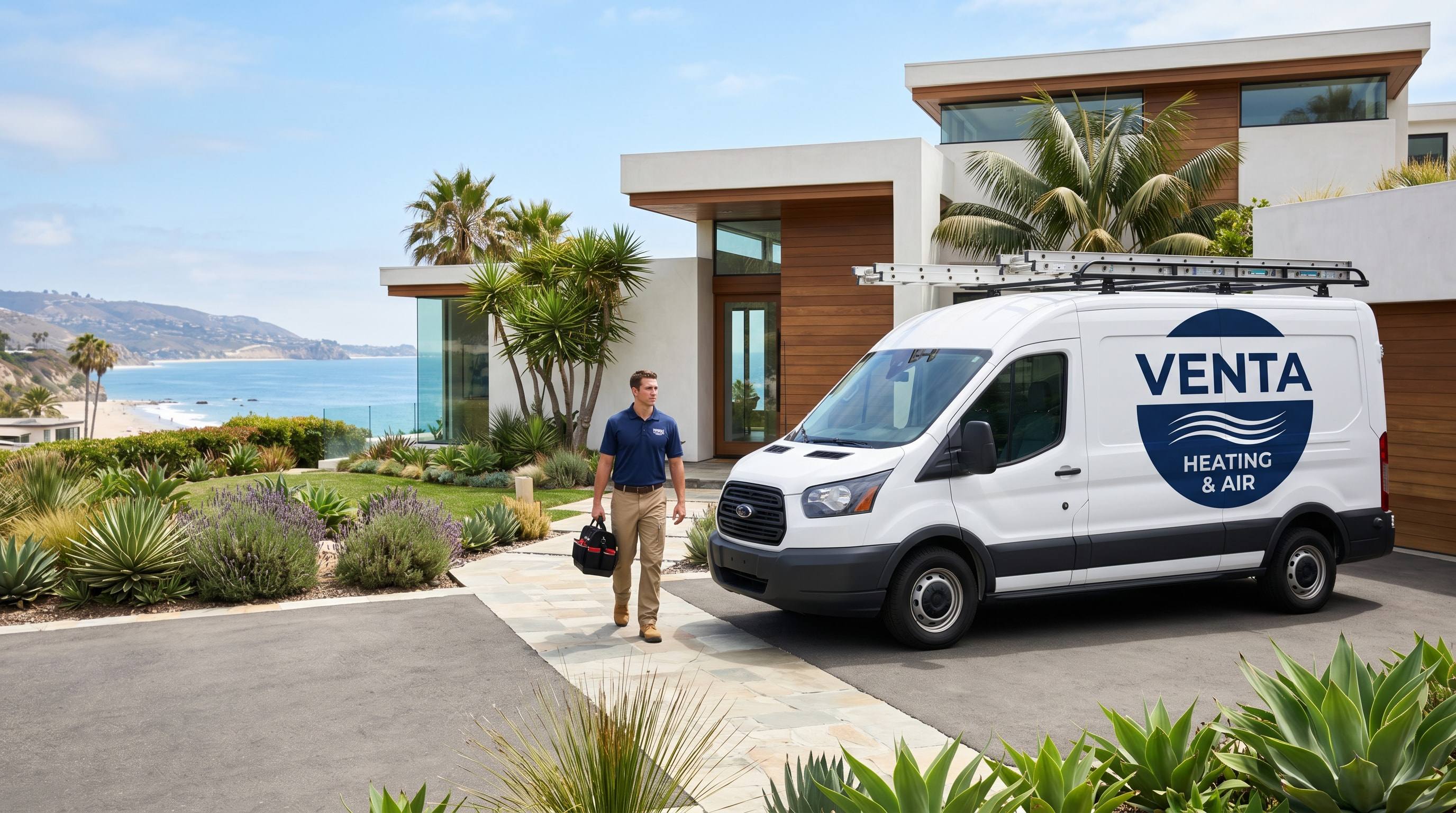
Laguna Niguel sits in a sweet spot most contractors don’t price correctly. You’re 3–5 miles from the Pacific, behind enough ridge and canyon that the salt-air corrosion that wrecks coils in oceanfront Dana Point and Laguna Beach drops sharply by the time onshore flow reaches your condenser. You’re also far enough inland that the cooling load is real, 60–80 days a summer above 80°F, with afternoon hilltop sun on the Marina Hills and Niguel Summit slopes. The contractor who quotes you the same equipment they’d quote a Newport Coast oceanfront home is overpaying you for corrosion protection you don’t need; the one who quotes you the same gear they’d sell in Tustin is underpaying you for the canyon-side onshore exposure. We size to Laguna Niguel specifically.
Why HVAC in Laguna Niguel is different
Three things separate Laguna Niguel from the rest of south Orange County, and each one changes the install. First, the coastal-influenced (not coastal) climate. Salt deposition drops by an order of magnitude every mile inland from the surfline; at 3–5 miles you’re in the band where standard galvanic coils with factory anti-corrosion coating last the same 10–12 years they’d last in Riverside. Coastal-grade equipment with E-coated fins and stainless fasteners is overspecification for most of the city. The exception is the canyon-side neighborhoods that catch a more direct onshore flow, Marina Hills, Bear Brand, and parts of Crown Valley closer to the 73, where we recommend the mid-tier corrosion-resistant option (Trane WeatherShield, Carrier WeatherArmor) as a hedge.
Second, the housing stock. Laguna Niguel was built in two main waves: the late 1970s through the 1980s (Niguel Shores, Kite Hill, Pacific Island Village), and the 1990s through the early 2000s (Bear Brand, Marina Hills, Niguel Summit, Beacon Hill, Crystal Cay). Almost every home in those waves shipped with builder-grade 10–14 SEER single-stage equipment matched to the cheapest gas furnace that met the era’s Title 24. Fourteen years is roughly when those systems hit their first real failure window. We’re replacing equipment in the late-1990s tracts every week now, and the early 2000s builds are 4–6 years behind them on the same curve.
Third, the lots and homes are bigger than tract OC. A typical Laguna Niguel home runs 2,500–4,500 sq ft, which puts most installs in the 4–5 ton range with longer duct runs and more complex zoning than a 1,800 sq ft Tustin tract. We Manual J every install, window orientation, ceiling heights, infiltration values, hilltop sun exposure on the southwest-facing afternoon side, because square-footage rules of thumb miss badly here.
Common HVAC issues we see in Laguna Niguel
- Refrigerant leaks at the evaporator coil on 12–15-year-old systems. The dominant failure mode for the 1990s and early 2000s installs reaching first replacement age. A coil leak typically costs more to repair properly than the residual value of the equipment.
- Capacitor and contactor failure on builder-grade outdoor units. Common on systems past year 10, especially those running long compressor cycles through August heat. $260–$420 repair if the rest of the system is healthy.
- Undersized AC from the original builder spec. Several 1990s tracts were spec’d to a 1-ton-per-600-sq-ft rule of thumb that’s 0.5–0.75 tons short for the actual hilltop sun exposure on the Marina Hills and Niguel Summit slopes. Owners notice it as “the back bedrooms never cool.”
- Duct leakage in attic-routed systems. Original flex duct from the 1990s tracts has typically lost 15–30% of its CFM to leaks at the take-offs. We test with a Duct Blaster as part of the HERS verification on every install.
- HOA-noncompliant condenser placement from prior contractors. We’ve been called in twice this year to relocate equipment that a previous contractor installed without architectural review, after the HOA flagged it on a property sale.
Equipment recommendations for Laguna Niguel
For most Laguna Niguel homes, the right answer is a variable-speed inverter system from a major manufacturer with the manufacturer’s mid-tier corrosion-resistant coil package. Three setups we install most:
- Trane XV20i variable-speed (4 or 5 ton) with WeatherShield-coated coil and matched TAM9 air handler. Quietest in the class at low-load run, eligible for SCE rebates, factory 12-year compressor warranty. Installed cost runs $14,500–$17,500 on a 4-ton replacement; $16,800–$19,500 on a 5-ton with dual-zone.
- Carrier Infinity 25VNA8 variable-speed with WeatherArmor coil and matched FE5 air handler. Equivalent comfort tier to the Trane, slightly different control architecture (Carrier’s Greenspeed inverter logic), 10-year parts warranty. Installed $14,200–$17,200 on a 4-ton.
- Lennox SL18XC1 two-stage as the “step down from variable” option for owners who want better than builder-grade without the variable-speed price. Two-stage compressor runs at low capacity 80% of the time, quieter than single-stage, modest efficiency gain. $11,500–$13,800 installed on a 4-ton.
For homes where a heat-pump conversion makes sense (no functional gas furnace, electric panel capacity available), the same Trane XV20i and Carrier 25VNA8 platforms are available as heat pumps and qualify for the active SCE rebate stack. Detail on full installation scope: AC installation service page.
A real Laguna Niguel example
Recent job: 3,200 sq ft Laguna Niguel home in the Niguel Summit area, 14-year-old Trane XV16 4-ton AC, customer reported reduced cooling capacity on the upstairs zone. Diagnostic ($89) found refrigerant 18% low, with the leak located at the evaporator coil. The repair quote was a coil replacement plus refrigerant recharge at roughly $2,800, on a system already at 14 years with builder-grade hardware elsewhere likely to follow within 2–4 years. The customer chose replacement: Trane XV20i 4-ton variable-speed heat pump with WeatherShield mid-tier corrosion-resistant coil, matched TAM9 air handler, R-454B refrigerant, total $15,800 installed, including permit, HERS verification, HOA submission packet, and removal of the old equipment. SCE territory; we filed the active 2026 rebate stack. TECH waitlisted at the time of install. Project finished within 6 days including HOA architectural approval.
Service area within Laguna Niguel and beyond
Our south-OC route from Irvine reaches every Laguna Niguel neighborhood: Bear Brand, Marina Hills, Niguel Summit, Kite Hill, Beacon Hill, Laguna Sur, Crystal Cay, Pacific Island Village, Niguel Shores, Rancho Niguel, El Niguel Heights, and the Crown Valley corridor. Coverage extends through Aliso Viejo, Mission Viejo, Laguna Hills, Dana Point, and San Juan Capistrano with comparable response times. Wider county view: Orange County HVAC.
Why Laguna Niguel homeowners choose Venta
Honest equipment selection. We’ll tell you when the coastal-grade upgrade isn’t worth it and we’ll tell you when it is. Manual J on every install instead of a square-footage guess. The HOA submission packet prepared as part of the quote, not as your homework. $89 standard diagnostic with a written fixed-price quote before any work, $149 after-hours. Permits pulled in your name, HERS verification scheduled by us, rebate paperwork filed for you. CSLB #1138898 (C-20). And we’ll tell you when a repair is the right call instead of pushing replacement on a system that has 3–4 good years left, even though the replacement quote is the bigger ticket.