
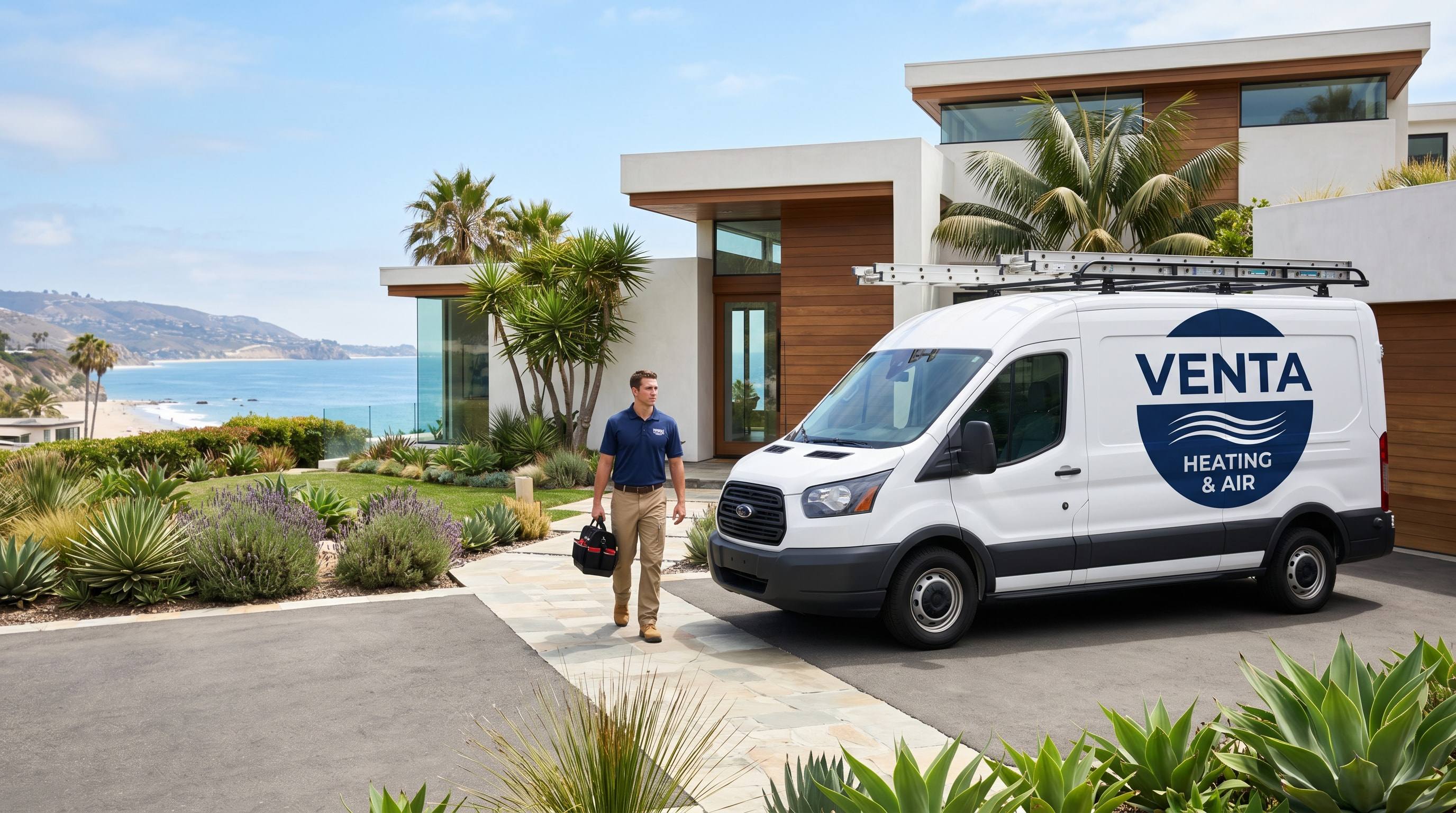
Newport Beach has a quieter HVAC problem than its inland neighbors: the AC doesn’t actually run that hard. Most of the city sits within a mile or two of the ocean, summer afternoons cap out in the high 70s with the marine layer doing half the cooling work, and the typical home runs the compressor maybe 60–70 days a year above 80°F. By the math of run-time alone, equipment should last 18–20 years here. It doesn’t. We replace condensers in coastal Newport at year 9–12 every week, because the ocean that keeps you cool is also salting your coil from the moment the unit ships.
That single fact — corrosion lifespan, not run-time lifespan — is what changes how an HVAC job in Newport should be quoted. The contractors who treat Newport like Irvine miss it. We don’t.
Why HVAC in Newport Beach is different
Two things define the work here. First, the salt-air corrosion math. Standard galvanic-coil outdoor units (the budget-tier 14–15 SEER condensers most of the door-knocking pitches lead with) typically show meaningful coil corrosion at year 5–7 in coastal Newport, versus 12–15 inland. The fin-tube interface oxidizes, the copper pits, and refrigerant leaks start showing up at U-bends and hairpin returns long before the compressor would otherwise wear out. Replacing a leaking coil on a still-functional 7-year-old condenser is throwing $1,800–$2,400 at a unit that’s already a year or two from compressor end.
Second, the housing stock spans almost a century of construction. The Balboa Peninsula has 1920s–1940s beach cottages with confined mechanical spaces and side yards too narrow for modern condenser footprints. Corona del Mar mixes 1950s flag-lot homes with newer ocean-view rebuilds. Newport Coast (the Pelican villages, Crystal Cove) is 1990s–2010s master-planned premium with architectural review boards. Lido Isle is bayfront 1930s–1960s with strict community-association aesthetics rules. Newport Heights is mid-century. Every one of these has different access constraints, different code-era electrical, and different HOA or community-association review processes.
The median Newport home was built in 1977 and is worth $2.4M+. The customer here expects equipment matched to the home, not equipment that’ll embarrass the listing photos in eight years.
Common HVAC issues we see in Newport Beach
The failure pattern is consistent and climate-driven:
- Outdoor coil corrosion and refrigerant leaks. Year 5–9 in coastal blocks. Diagnosis is a leak-search with electronic detector or UV dye; the fix is rarely worth it on standard-coil equipment because the rest of the unit is on the same corrosion clock.
- Condenser fan motor and contactor failure. Salt deposits on the contactor pads and motor bearings. Capacitor failures show up too, but the motor and contactor are the salt-air signatures.
- Ductwork moisture issues. Marine layer humidity plus poorly insulated attic ducts equals condensation, sweating registers, and occasional drywall staining. We add R-8 duct insulation and seal supply boots on retrofit.
- Older Balboa cottages with no real return path. Many 1920s–1940s structures had cooling added in the 1970s with a single hallway return that’s undersized by modern standards. Static pressure runs high, blower wheels load up with salt-air dust, and the system never quite balances.
- Heat exchanger cracking on coastal-installed gas furnaces. Less common but worth mentioning — we see it in Peninsula and CdM installs that haven’t had a flue inspection in a decade.
Equipment recommendations for Newport Beach
The honest version: in coastal Newport, we don’t lead with the cheapest equipment, because it doesn’t work out cheaper. Our default coastal spec, by tier:
- Trane XV20i variable-speed condenser with all-aluminum spine fin coil. Single-piece aluminum coil eliminates the dissimilar-metal corrosion path entirely. $13,500–$17,000 installed for a 3–4 ton system with matched air handler. This is what we install most often in Newport Coast and on ocean-view CdM rebuilds.
- Carrier Infinity 25VNA8 with WeatherShield protection. Factory baked-on coating over the standard coil. Not as bulletproof as all-aluminum, but a meaningful step up from raw galvanic and a strong fit for inland-Newport blocks (Newport Heights, Eastbluff, parts of CdM north of PCH). $11,500–$14,500 installed.
- Lennox XC25 with factory coastal coating. Comparable to the Carrier in protection level and a good option when matching an existing Lennox air handler. $11,000–$14,000 installed.
For furnace and air-handler matching: the indoor side is fine in standard configurations because the corrosion problem is exterior. For full electrification, we pair the above condensers as heat pump systems with matched variable-speed air handlers and remove the gas furnace if the customer wants the SoCalGas furnace-removal incentive.
Real-world example: Newport Coast 4-bedroom replacement
A 4-bedroom Newport Coast home with a 12-year-old Carrier 24ABB6 4-ton AC called us last year about gradual cooling capacity loss. Diagnostic visit found refrigerant 22% low and an evaporator coil leak at a U-bend — salt-air-influenced corrosion classic pattern. The customer chose full system replacement rather than coil-only repair, given the original unit was past its corrosion service life regardless. We installed a Trane XV20i 4-ton with all-aluminum spine fin coil and matched variable-speed air handler at $16,800 fully installed, including permit, HERS verification, and Newport Coast architectural review packet. SCE territory (no LADWP rebate). TECH Clean California funds were already fully reserved by November 14, 2025 — we filed the reservation on the waitlist anyway in case of reopen. Federal IRA Section 25C ($2,000 heat-pump credit) was not in the math because that program terminated December 31, 2025 under the One Big Beautiful Bill Act. Active rebate stack on this job: SCE rebate ($600) plus SoCalGas furnace-removal incentive ($300), netting $15,900.
Service area within Newport Beach
Our Irvine dispatch covers all Newport ZIP codes: 92625 (Corona del Mar), 92657 (Newport Coast), 92660 (Newport Beach core, Eastbluff, Big Canyon), 92661 (Balboa Peninsula), 92662 (Balboa Island), and 92663 (West Newport, Newport Heights, Lido Isle, Balboa Peninsula north). Neighborhoods we work in regularly: Newport Coast (Pelican Hill, Pelican Crest, Pelican Ridge, Crystal Cove), Corona del Mar (the flower streets, Old CdM, Cameo Shores), Newport Heights, Eastbluff, Big Canyon, Harbor View Hills, Dover Shores, Bayshores, Lido Isle, Balboa Island, Balboa Peninsula (West Newport, Peninsula Point), and Santa Ana Heights. Beyond Newport: Irvine, Costa Mesa, Huntington Beach, and southern Orange County. Wider view: Orange County HVAC.
Why Newport Beach homeowners choose Venta
- We spec corrosion-resistant equipment by default in coastal Newport — not because it’s a fancier sale, but because it actually lasts here.
- HOA architectural review packets are our work. We submit cut sheets, sound spec sheets, dimensioned site plans, and elevation drawings on every Newport Coast and Crystal Cove job.
- Property manager coordination on Balboa Peninsula vacation rentals and short-term rentals is a routine workflow, not a special request.
- Permits pulled in the owner’s name through the City of Newport Beach Building Division. Title 24 / HERS verification scheduled by us with a third-party rater.
- Diagnostic fee $89 standard, $149 after-hours (after 8 PM), applied to repair cost if you proceed. Written upfront pricing before any work.
- 60–90 minute response from Irvine on same-day calls during business hours. Phones answered 24/7 by a live human; field dispatch runs 8 AM–8 PM.
- CSLB #1138898 (C-20) — fully licensed and bonded for HVAC work in California.
If you’re weighing a coil repair against a full replacement on a 7–10-year-old coastal unit, or you’ve been quoted a budget-tier condenser for a Newport Coast home, call before committing. We’ll give you both numbers in writing and the corrosion math behind which one actually saves money over the next decade.