
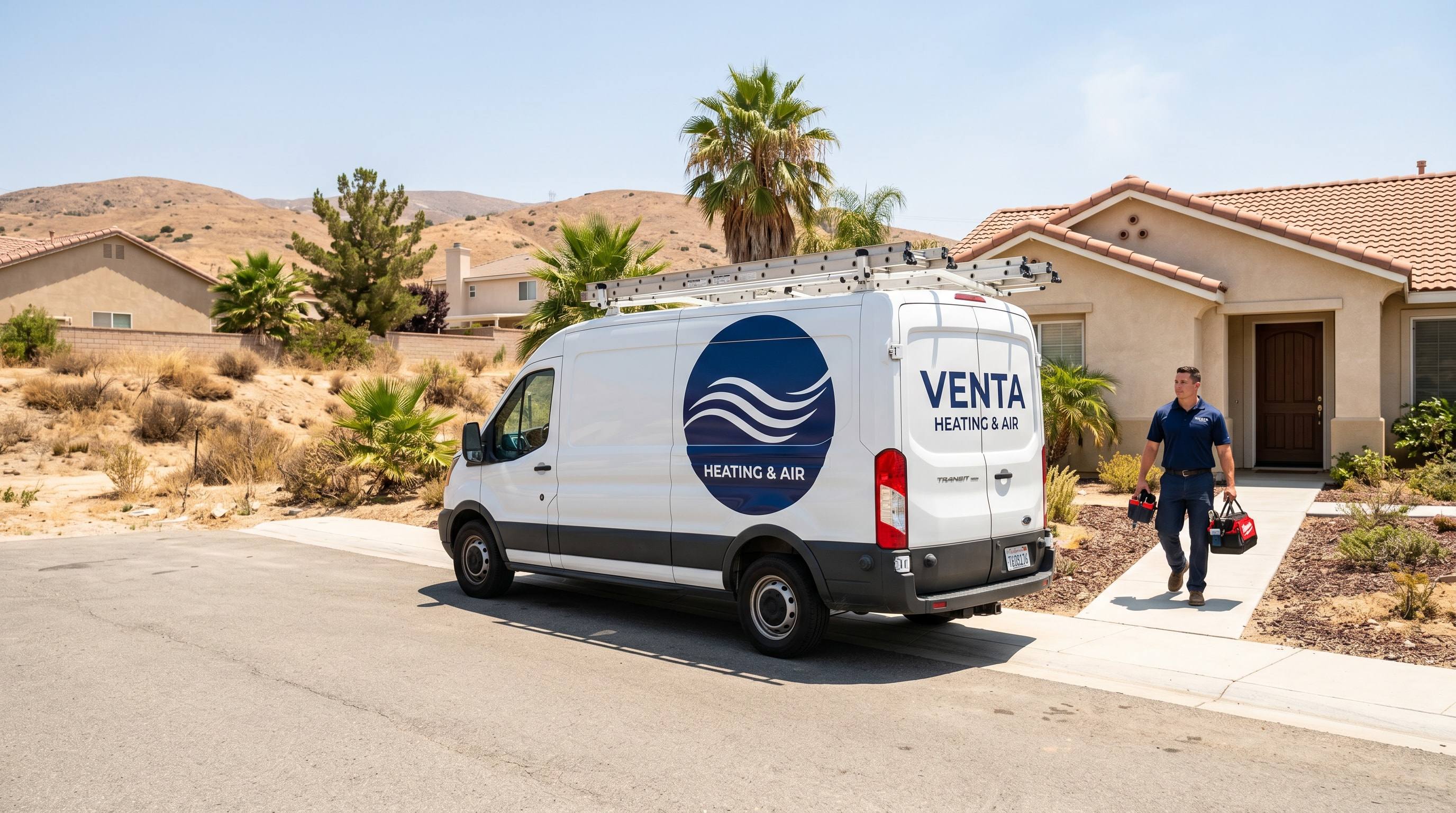
Most of the friction in a Palm Desert HVAC job isn’t the equipment. It’s the architectural review board.
You buy a home in The Lakes, or Indian Ridge, or Sun City Palm Desert, or Marrakesh, and the original 18-year-old condenser finally gives out in August. You call three contractors. Two of them quote the equipment, schedule the install, and never mention the HOA package. The install happens, the unit goes in, and three weeks later the design-review committee writes you a letter demanding it be moved, screened, or replaced because it sits 4 inches outside the approved equipment envelope, exceeds the 65 dB property-line sound limit at high stage, or doesn’t match the approved finish list. Now you’re paying for the install twice.
This is the problem we built our Palm Desert process around. The equipment is desert-grade and the techs know what they’re doing, but the part that actually saves the customer money is the paperwork that gets done before the truck shows up.
How the HOA submission actually works
Our process on every quote in an HOA-governed community: we pull the architectural guidelines at scoping, identify the sound limit (almost always 65 dB at property line, sometimes lower for shared-wall communities), the equipment placement zone, the screening requirement, and the approved finish list. We spec equipment that complies, slim-profile inverter condensers from Carrier Infinity, Mitsubishi M-Series, Daikin Fit run 55–62 dB at high stage, comfortably under almost every Coachella Valley HOA threshold. Then we prepare the design-review packet (equipment specs, placement diagram, screening drawing, sound-rating documentation) and submit it to the committee on your behalf. Approval timelines run 2–6 weeks depending on the community; we tell you that at quote time so you can plan around it.
The HOA coordination is the contractor’s job, not yours. If a vendor asks you to chase architectural approval, that’s a signal to call someone else.
The other Palm Desert problem: dust on uncoated coils
Coachella Valley wind events drive fine desert particulate into outdoor coil fins. Standard residential equipment without anti-corrosion coil coatings shows measurable performance degradation by year 3 and outright failures by year 7–9 — well short of the 15-year service life the manufacturer brochure quotes. We don’t install uncoated equipment in Palm Desert. Default specs:
- Rheem RA17AZ desert package, coil coating plus sealed electrical compartments.
- Carrier Performance Seacoast (the coastal spec doubles as desert spec).
- Mitsubishi M-Series inverter as standard.
- Daikin Fit with desert kit on premium installs.
The premium runs $400–$900 over baseline. It’s the difference between a system that lasts 12–15 years here and one that lasts 7. Same approach as our Palm Springs page.
Snowbirds and the empty-house months
Half the residential properties we maintain in Palm Desert are empty May through September. Owner is in Vancouver or Calgary or somewhere in the Pacific Northwest, the AC is running 18–22 hours a day in 115°F to keep the interior at 78°F, and there’s nobody walking past the system to notice the condensate pump backing up or the filter loaded.
Our absentee-owner package handles this. Spring tune-up before arrival, mid-summer drive-by during peak run-time (filter check, coil rinse, condensate verification, refrigerant pressure read), fall tune-up after departure, priority dispatch if anything fails. $295/year. Optional add: smart-thermostat remote monitoring that emails you if interior temperature drifts outside set bounds, cheap insurance against the system having quietly died three weeks before you noticed. Detail: maintenance plans.
El Paseo and the commercial corridor
El Paseo (the “Rodeo Drive of the Desert”) runs galleries, fashion retail, restaurants, jewelry, professional offices and medical suites along a 1.5-mile stretch off Highway 111. Tenant HVAC scope: rooftop package units on the older single-story buildings, split DX on the newer mixed-use, ductless mini-split for tenant improvements that didn’t exist when the building was designed, Mitsubishi VRF on multi-tenant medical and professional buildings, kitchen makeup-air on the restaurant tenants. Most El Paseo retail wants maintenance work outside operating hours; we run after-hours and pre-open windows on service contracts.
The Sun City math is different
Sun City Palm Desert and the larger 55+ communities have a distinct customer profile: long-tenure ownership, value-focused on cost-of-ownership over headline efficiency, real interest in the rebate stack. We tend to quote two-stage mid-tier equipment paired with desert-spec corrosion treatment rather than premium variable-speed inverter, unless run-time and ownership horizon support the inverter premium. The 2026 rebate stack is smaller than 2025 was: TECH Clean California ($3,000–$8,000, income-tier dependent) is currently waitlisted on single-family heat pump HVAC (funds fully reserved November 14, 2025); HEEHRA fully reserved February 24, 2026. Federal IRA 25C ($2,000) was terminated December 31, 2025 under OBBBA. The active 2026 stack is SCE rebates ($300–$1,200) plus SoCalGas furnace-removal incentives, which moves the net invoice on heat-pump conversions but less than the 2024-2025 stack did. We submit TECH reservations on every qualifying install in case funding reopens. Detail: TECH Clean California rebates and the verified 2026 rebate guide.
What we cover
- AC repair and replacement, desert-grade equipment as standard.
- Heat-pump installation with full rebate filing.
- Snowbird and absentee-owner maintenance.
- HOA design-review submission and coordination.
- El Paseo and commercial-corridor light-commercial.
- 24/7 emergency dispatch at (951) 744-9188.
Coverage
Palm Desert proper plus Palm Springs, Indio, Rancho Mirage, Indian Wells, La Quinta, and Bermuda Dunes. Wider county view: Riverside County HVAC.
CSLB #1138898 (C-20). Permits pulled in your name. HERS verification on every replacement.