
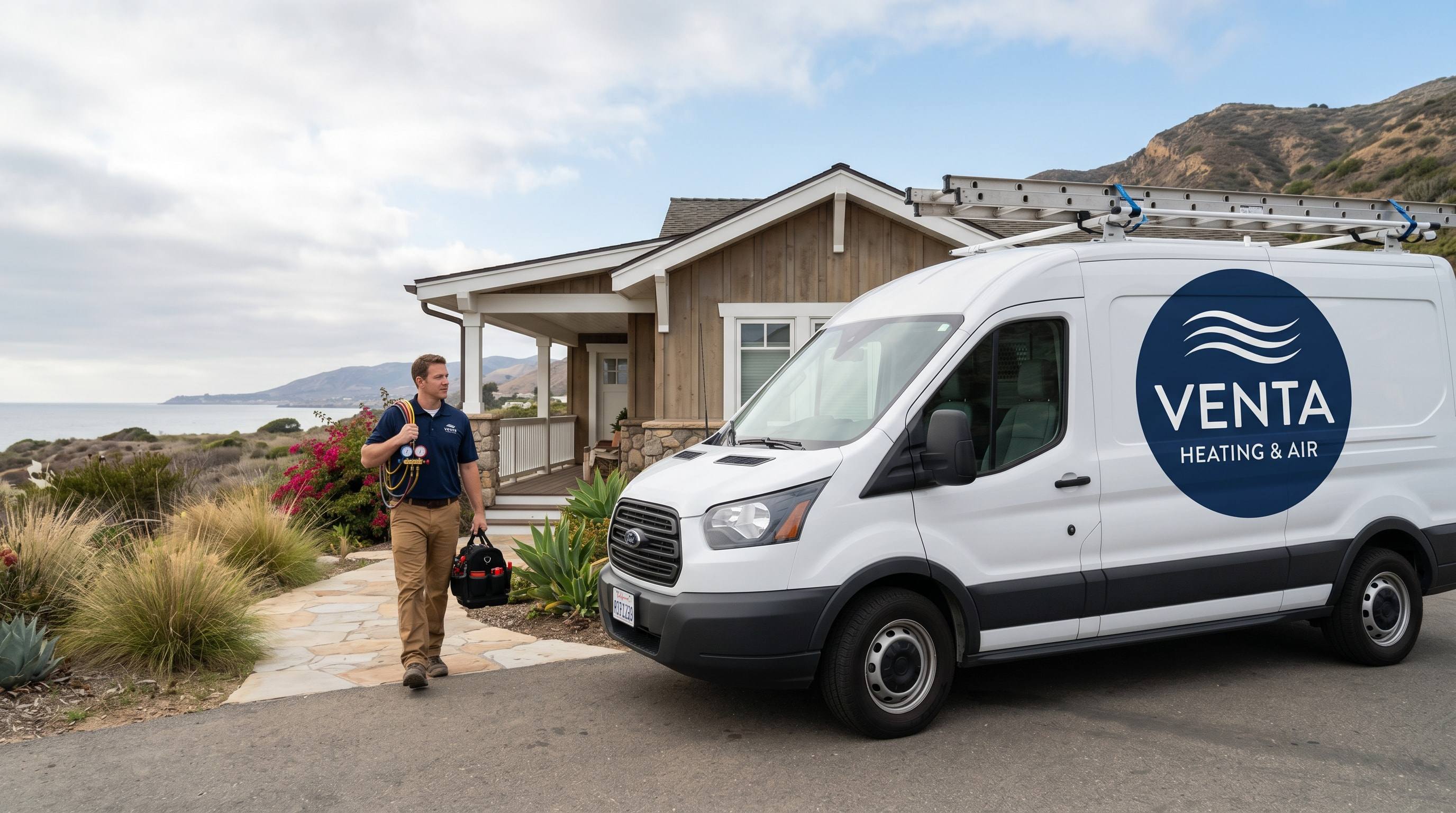
The HVAC failure that catches Simi Valley homeowners off guard isn’t the AC dying. It’s the AC that was sized correctly for a coastal Southern California climate (by an installer who didn’t walk outside before quoting) finally hitting a 105°F July afternoon and discovering it can’t hold the setpoint.
The Santa Susana Mountains form a wall between Simi Valley and the Pacific. Marine-layer cooling that reaches Oxnard and Ventura by 2 p.m. doesn’t make it over the ridge most summer days. The valley sits in its own pocket, holding heat through the afternoon and well into the night — we’ve measured overnight lows above 78°F during multi-day heat events. The 1% design temperature for proper Manual J sizing in Simi runs 102–104°F. Most installs we audit on diagnostic calls were sized off generic Southern California rules of thumb in the high 90s. The undersized result is the same in both cases: a system pinned at maximum capacity for the worst weeks of summer, dying years sooner than it should, leaving the house at 80°F at 5 p.m. on the days the homeowner most needs it cool.
Sizing the system right is the first half of how we run service in Simi Valley. The second half is what we do about wildfire smoke.
The Easy Fire problem and how we layer the response
The 2019 Easy Fire burned against the northeast edge of Simi near the Reagan Library, and the city catches seasonal smoke from broader regional incidents most years. Single-point IAQ defenses don’t hold up under repeated event exposure. The layered approach we install most often:
- MERV 13 in the central system, with a 4-inch media filter cabinet retrofit on most pre-2010 air handlers to handle the static pressure ($200–$400).
- Whole-house bypass HEPA for severe-event days ($1,800–$2,800).
- Closing the fresh-air intake during PSPS and red-flag warnings.
- A post-event maintenance call after major incidents (filter swap, coil rinse, blower clean) to reset baseline IAQ.
The 1980s tract problem — you’re probably on your second replacement
If you live in Wood Ranch, Big Sky, Texas Tract, Indian Hills, Mountain Gate, Stargaze, or Madera, the original builder-grade equipment was likely replaced once already (somewhere between 2000 and 2010) with a 13–14 SEER unit that is itself now aging out. Second-cycle replacement is a different engineering problem from a first-cycle replacement. The line set has been pulled at least once. The ducts have been re-secured. The electrical is documented. And you’re replacing equipment selected by someone else’s sizing call rather than the original builder’s.
For your typical 2,000–2,800 sq ft Simi home, a properly sized 16+ SEER variable-speed system installs at $8,500–$13,500 including condenser, matched air handler or coil, line-set replacement if R-22 was the original refrigerant, electrical, permit, and HERS verification.
The HOA paperwork problem
Most Simi Valley neighborhoods are HOA-managed, including Wood Ranch, which is one of the strictest architectural-review communities in the county. We prep the submission packet on every install: cut sheets, dB ratings, dimensions, site-plan markup, screening details. Approval typically lands in 2–4 weeks. If a contractor doesn’t mention HOA approval at quote time and your equipment ends up rejected after install, you’re paying for the install twice. Don’t do that.
The commuter-window problem
Most Simi residents commute over the Santa Susana Pass to the San Fernando Valley or to LA. Peak HVAC demand (the time when a system failure becomes urgent) is evenings and weekends, not midday Tuesdays. We staff dispatch evenings and weekends accordingly. (805) 977-9940, live human answering.
The TECH Clean rebate stack
Simi’s middle-class homeowner base is well-positioned for the standard or moderate-income TECH Clean tier on heat-pump replacements. Substantial portions of the city qualify for the moderate or low-income tier on top of that.
- SCE: heat-pump and smart-thermostat incentives ($300–$1,200). Active.
- SoCalGas: furnace-removal incentive when capping the gas line. Active.
- TECH Clean California: $3,000 standard / $4,000 moderate (80–150% AMI) / up to $8,000 low-income (<80% AMI) when funded. Status as of May 2026: single-family heat pump HVAC funds fully reserved November 14, 2025; HEEHRA fully reserved February 24, 2026. New reservations go on a waitlist; we submit on every qualifying install.
- Federal IRA Section 25C: terminated December 31, 2025 under OBBBA. No longer available for 2026 installs.
Worked 2026 example: $9,800 quoted on a 4-ton variable-speed heat pump replacing a 17-year-old gas furnace plus AC. SCE $400. SoCalGas $300. Active-stack net: $9,100. If TECH funding reopens during the project window, the $3,000 standard tier deducts on top, dropping net to $6,100. Detail: TECH Clean California rebates and the verified 2026 rebate guide.
What we cover
- AC repair with $89 diagnostic and a written quote before any work.
- AC installation sized for the actual 102–104°F Simi design condition.
- Heat-pump installation with full TECH rebate filing.
- Indoor air quality retrofits and post-fire-event maintenance.
- Furnace service for winter mornings in the high 30s.
- Duct cleaning and HERS testing.
- 24/7 emergency dispatch.
Coverage: Simi Valley proper plus Moorpark, Thousand Oaks, Chatsworth, and Northridge. Wider county view: Ventura County HVAC. CSLB #1138898 (C-20). Permits and HERS pulled in your name.