
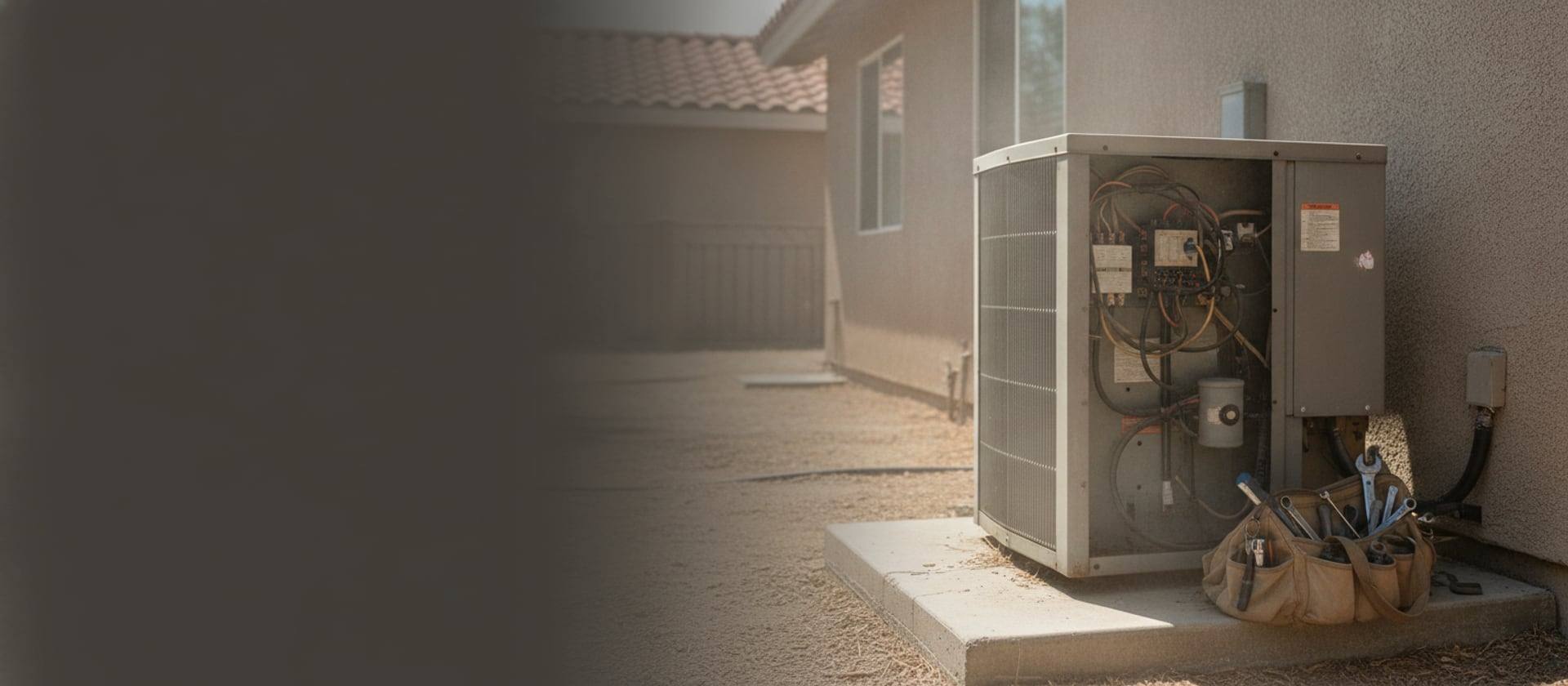
Here is something most homeowners do not know: the most common AC repair we run all summer is not what most people assume. It is not a refrigerant leak, it is not a bad capacitor, it is not a dying compressor. Roughly half the "broken AC" calls we get from June through September trace back to a $0.50 problem inside a 3/4-inch PVC pipe nobody ever looks at. The pipe is your condensate drain line, and you can usually clear it with a cup of distilled vinegar and twenty minutes.
If you noticed a puddle near your indoor air handler today, your AC shut itself off, or there is a fresh wet stain blooming on a ceiling under an attic unit, this is your problem. Skip the panic phase. Read on.
Why a $0.50 problem can shut down a $9,000 system
Air conditioners cool by passing warm indoor air over a cold evaporator coil. Same physics as a glass of ice water sweating on the counter, the coil pulls moisture out of the air. That water has to leave. It collects in a drain pan under the coil and exits through the 3/4-inch PVC condensate drain line, which usually terminates somewhere harmless: out the side of the house, into a floor drain, or up to a sink via a small condensate pump.
A 3-ton residential AC running through a SoCal August produces 3 to 15 gallons of condensate a day depending on local humidity. Coastal homes in Santa Monica and El Segundo make more, dry inland homes near Palm Springs make less, but every one of those gallons has to go somewhere.
Modern systems include a float switch in the drain pan. When the line clogs, the pan fills, the float lifts, and a tiny switch shuts the entire system off. To you, it looks like the AC died on the hottest afternoon of the year. To us, it looks like the safety did exactly what it was supposed to do.
Tells that point at the drain line
- Standing water around the indoor air handler or pooled in the closet floor
- The AC shut itself off and the thermostat will not bring it back
- A new wet stain on the ceiling under an attic-mounted unit
- Musty or moldy smell when the system runs
- Drip from the secondary drain pan, the metal pan that sits under the unit specifically to catch overflow
- The outdoor termination of the drain line is dry on a hot afternoon when it should be dripping steady
Why these clog, especially out here
The drain pan is dark, wet, and warm year-round, which is exactly the climate algae, mold, and biofilm thrive in. The slime grows on the inside walls of the line, narrows it to a trickle, then closes it. Higher coastal humidity grows it faster; we see Santa Monica and Long Beach systems clog twice as often as Riverside or Pasadena.
Older homes (1950s through 1970s) often have undersized half-inch drain lines that clog at the slightest provocation. Newer 3/4-inch lines hold up longer. Beyond biofilm, drain lines can also fail from dust and pet hair finding its way to the drain pan, low spots in poorly sloped runs that hold water and feed faster growth, or condensate pumps that quietly stop pumping.
The vinegar method
Standard maintenance move. Twenty minutes, $5, fixes most clogs.
- Thermostat to OFF. Then kill power at the breaker for the indoor unit. Do not skip the breaker step. The float switch can re-energize the system once water levels drop, and you do not want that happening with the access cap off
- Find the drain access point. Look at the 3/4-inch PVC pipe coming out of the air handler. There is a T-fitting somewhere along it with a removable cap on top, that is your entry
- Pop the cap. Have a rag or a small bowl ready, if the line is fully blocked, water comes up the moment the cap moves
- Pour 1 cup of distilled white vinegar down the open T. Do not use bleach. It corrodes drain pans, attacks PVC over years, and reacts badly with rubber float seals
- Wait 30 minutes. The vinegar dissolves the biofilm. While you wait, walk around the house to find the outdoor termination of the line, usually a stub of PVC sticking out near the foundation
- Flush with 2 to 3 cups of plain water down the T. Watch for flow out the outdoor stub
- Cap back on. Breaker back on. Thermostat back on. Confirm the system runs and the float switch has reset
Free flow at the outdoor outlet, you are done. Still no flow, time for the vacuum.
When vinegar does not move it
The wet/dry vacuum method works on stubborn clogs that vinegar alone could not soften. Five extra minutes, requires a Shop-Vac, Ridgid, or Craftsman wet/dry shop vacuum.
- Find the outdoor end of the drain line, 3/4-inch PVC, 6 to 18 inches off the ground typically
- Attach the vacuum hose to the outdoor pipe. If diameters do not match, wrap the joint in a wet rag to seal it, or pick up a rubber drain adapter from any hardware store for under $5
- Run the vac for 2 to 3 minutes. You will hear the slime, water, and debris pull into the canister
- Pour 1 cup of vinegar down the indoor T as a final flush
- Cap, breaker, thermostat, all back on. Within 5 to 10 minutes of normal cooling operation you should see steady drip from the outdoor outlet
This clears roughly 95% of residential drain clogs we would otherwise have rolled a truck for. The 5% it does not solve usually means a collapsed line behind a wall, a dead condensate pump, a hole in the drain pan, or a frozen evaporator coil dumping more melt water than the drain can carry (separate issue, see frozen evaporator coil).
Keep it from happening again
Three habits prevent essentially all of these calls:
- Pour 1 cup vinegar down the T every 3 months during cooling season. Phone reminder set for the first of April, July, and October. Two minutes each time
- Change the filter on schedule, less dust into the air handler means less sediment in the drain pan. Filter replacement guide
- Glance at the outdoor drain stub during a heat wave. The AC is working hard, you should see a steady drip. Bone dry while the system runs means something is blocking the flow upstream
Annual float-switch test: pour a cup of water directly into the drain pan, confirm the AC shuts off, then reset the float to clear the lockout. That tells you the safety is actually working before you need it.
If none of that fits in your life, our maintenance plans include drain-line clearing as part of every spring tune-up. $349/year for the two-visit plan.
The honest limit of DIY here
Sometimes the cheap fix doesn’t pencil. Call us if:
- Vinegar and the wet/dry vacuum both did not move the clog
- The pan keeps filling within days of you clearing it, recurring clogs that fast point at slope, sizing, or biofilm rooted in the coil itself
- You see ice on the larger insulated copper line near the indoor unit, that is a frozen coil overwhelming the drain, separate problem
- The float switch keeps re-tripping after you reset it
- Water has migrated into walls, drywall, or subfloor. We can clear the AC issue, but you may also need a moisture-restoration outfit before mold takes hold
$89 fixed-price diagnostic, written quote before any work. Detail: AC repair. If the AC is also blowing warm air, that is a different overlap, see why your AC isn’t blowing cold air.
Call Venta Heating and Cooling at (424) 766-1020, same-day service across Southern California. CSLB #1138898 (C-20).