
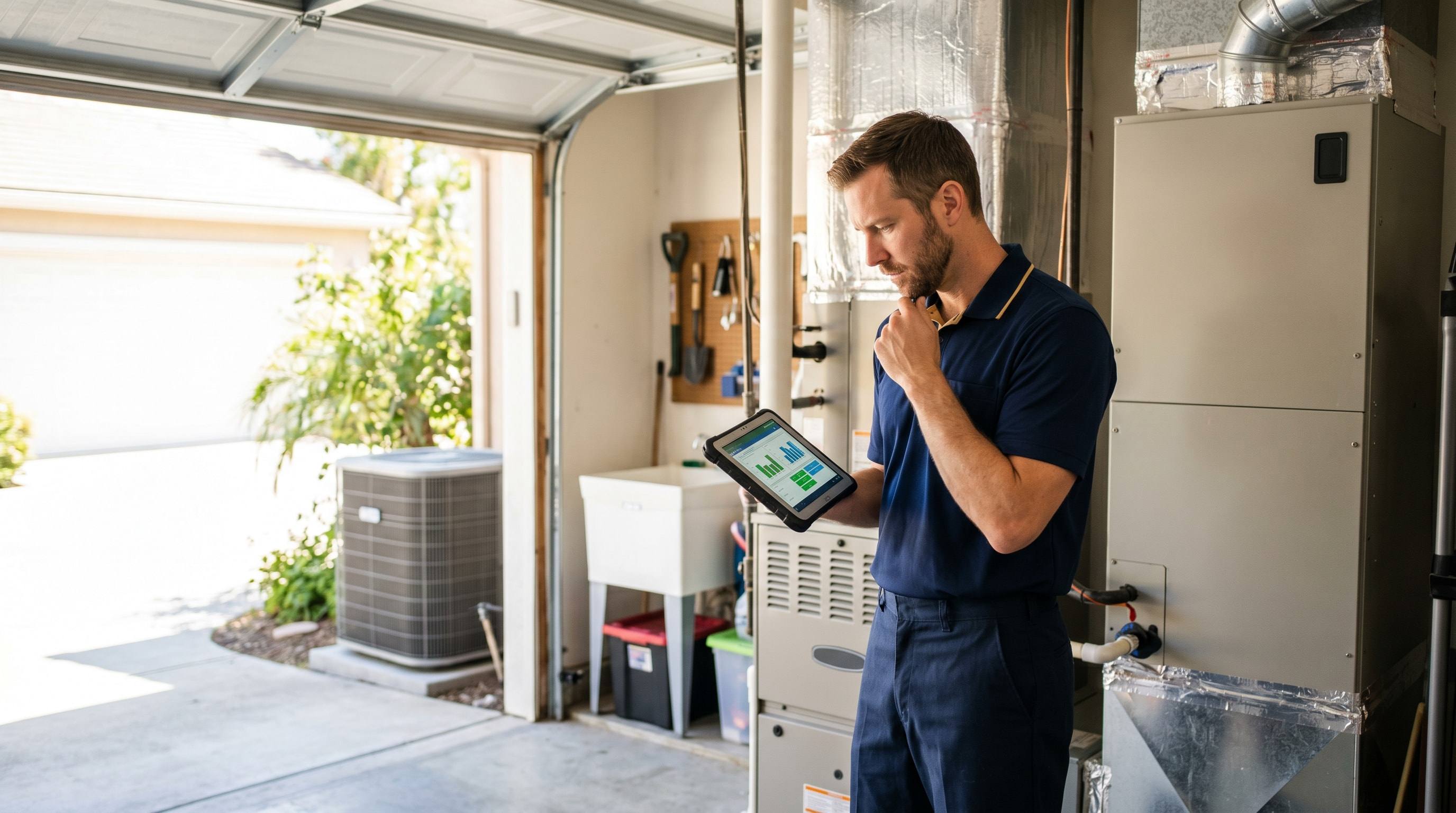
“HVAC repair” covers more than people think. Most homeowners call when the AC blows warm air or the furnace won’t fire, but a real HVAC repair shop fixes the whole system: cooling, heating, ductwork, controls, refrigerant circuits, gas appliances, condensate handling, and the smart thermostat that ties it all together. We send one truck, diagnose the real cause, and quote the repair upfront before touching a tool.
AC repair, furnace repair, HVAC repair — what’s the difference?
Plain English: AC repair is specifically the cooling side (condenser, evaporator coil, refrigerant circuit, blower in cooling mode. Furnace repair is the heating side) gas valve, ignitor, flame sensor, heat exchanger, draft inducer. HVAC repair is the umbrella: cooling, heating, ductwork, ventilation, controls, thermostat, zoning, and anything that touches both. If you don’t know which one your problem falls under, this is the right page; we’ll figure it out at the diagnostic. Quick links if you do know: AC repair, furnace repair.
How we run the diagnostic — what we check first
The $89 diagnostic isn’t a 5-minute glance. A real HVAC diagnostic covers, in order:
- Symptoms interview. When did it start? Sudden or gradual? Any noises, smells, breaker trips, water?
- Thermostat verification. Calling correctly? Battery? Wired right? Many "broken HVAC" calls end here for $0 in parts.
- Filter and return-air check. A filter not changed in 6 months mimics 90% of bigger problems: see AC filter replacement.
- Outdoor unit inspection. Coil cleanliness, fan operation, contactor, capacitor microfarads, line-set temps, refrigerant pressures.
- Indoor unit inspection. Blower amp draw, static pressure, evaporator coil condition (frozen? dirty?), drain pan and condensate line.
- Furnace inspection (year-round, not just winter): ignitor resistance, flame sensor microamp draw, gas valve, heat exchanger, inducer.
- Electrical. Disconnect, breaker amp draw, control board, low-voltage wiring.
- Ductwork. Visible leaks, supply/return temp split, static pressure.
By the end of the diagnostic we know what failed, why it failed, and what it costs to fix. You get a written quote before we touch the next tool.
Honest pricing, written down
Real flat-rate prices for typical HVAC repairs in Los Angeles:
- Run capacitor, the #1 cooling-season failure: $185–$295.
- Contactor: $195–$320.
- Condensate pump or float switch: $220–$420.
- Furnace ignitor: $245–$485.
- Flame sensor clean/replace: $185–$295.
- Condenser fan motor: $420–$780.
- Blower motor (ECM or PSC): $480–$890.
- Draft inducer motor: $580–$1,100.
- Gas valve: $385–$685.
- Control board: $480–$950.
- Refrigerant leak repair: $480–$1,800 depending on access and refrigerant type.
- Compressor replacement: $1,800–$3,400 (we always quote replacement at this level).
The diagnostic ($89 business hours, $149 after hours) rolls into the repair if you proceed. Decline the repair, you pay only the diagnostic.
Seasonal patterns — what we’re seeing this week
Southern California HVAC failures cluster predictably:
- May–June: First-call-of-the-season failures. Capacitors that survived spring start-stop dying on first hot day. Frozen coils from filters that haven’t been changed since last fall (why your coil freezes).
- July–September: Heat-wave failures. Capacitors, contactors, compressors stressed by 95°F+ continuous load. Coastal humidity drives condensate pump failures. AC blowing warm air calls peak (diagnostic guide).
- October–November: Santa Ana season. Voltage sags, debris ingestion. Then the cooling/heating switchover: furnace ignitors fail on first heating call. (Santa Ana effects.)
- December–February: Furnace season failures. Flame sensors fouled by summer dust, ignitors at end of life, control board failures from voltage spikes. Pilot light won’t stay lit calls peak.
- March–April: Spring tune-up season, when most July failures get caught early.
Strange noises? See HVAC strange noises. Furnace blowing cold? Furnace blowing cold air. Furnace short-cycling? Short-cycling guide. Permit, A2L refrigerant, and HERS context: complete California HVAC code guide.
When to repair, when to replace
We run three rules on every repair quote over $1,000:
- The 50% rule. Repair > 50% of replacement cost on a system 10+ years old: replace.
- The $5,000 rule. Age × repair quote > $5,000: replace.
- The R-22 rule. Pre-2010 R-22 systems: refrigerant repairs throw money at a system you’ll replace anyway. R-22 is now $200–$400/lb.
If the math says repair, we repair and leave. If it says replace, we point you to AC replacement, furnace installation, or heat pump conversion, including the active 2026 utility rebates (LADWP heat pump $1,250–$2,500 per ton, SoCalGas furnace up to $25/kBtuh, SCE $300–$1,200). Federal IRA 25C tax credit was terminated December 31, 2025 under OBBBA; TECH Clean California single-family heat pump HVAC is currently waitlisted. For the verified rebate program list, see our 2026 California HVAC rebate guide.
Service areas
HVAC repair across Los Angeles, Orange, Ventura, San Bernardino, and Riverside counties. Regional dispatch numbers in footer. After-hours problems route through our 24/7 emergency line.