
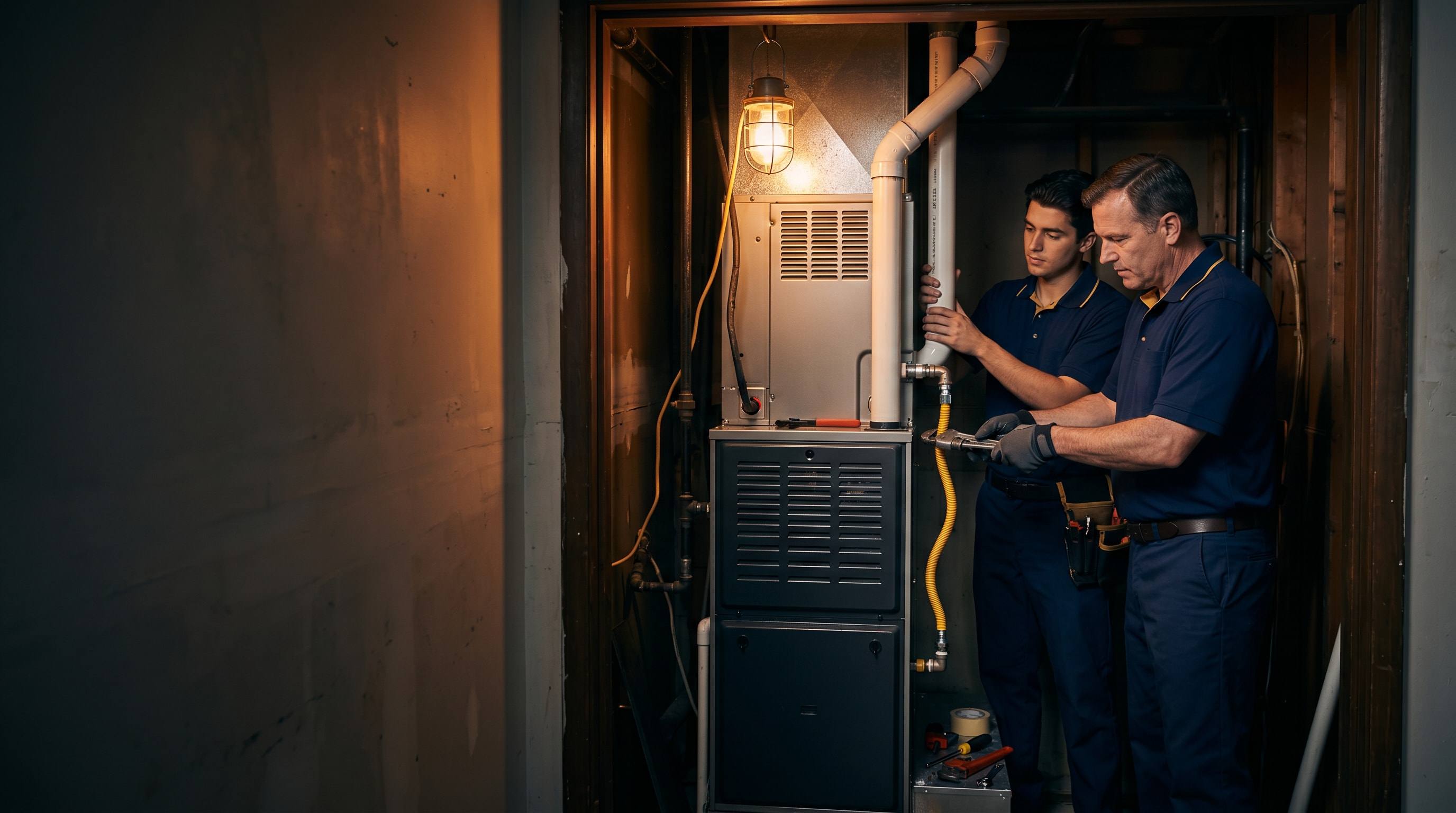
Yes, Los Angeles needs heat. The cliché is that nobody in Southern California owns a winter coat — but anyone who’s woken up in Northridge in January at 41°F, or in Thousand Oaks with frost on the windshield, knows the furnace earns its money four months a year. We install heating systems across all five Southern California counties with proper permitting, current-code venting, accurate Manual J sizing, and rebate paperwork done for you.
The LA winter most homeowners underestimate
Coastal cities (Santa Monica, Malibu, El Segundo) sit at 50–58°F overnight in January. Inland and elevated zones tell a different story:
- San Fernando Valley (Van Nuys, Sherman Oaks, Woodland Hills): regular 42–46°F nights, occasional dips to 38°F.
- San Gabriel Valley (Pasadena, Arcadia, Glendale): similar to the Valley with cold-air drainage off the foothills on still nights.
- Ventura County inland (Thousand Oaks, Simi Valley, Moorpark): frost mornings every winter, several nights in the high 30s.
- San Bernardino mountains (Big Bear, Wrightwood, Crestline): actual winter, sub-freezing weeks, snow accumulation, furnace runs almost continuously.
- Antelope Valley & Inland Empire: dry, cold nights regularly drop into the low 30s through January and February.
Most homes in these zones were built in the 1960s–80s with R-11 wall insulation, single-pane aluminum windows, and ducts in the attic. When the furnace fails, the indoor temperature tracks the outdoor temperature within 4–6 hours. Heating isn’t optional in a Big Bear cabin, and it’s not really optional in Northridge in January, either.
What “a furnace install” actually includes
A code-compliant heating system installation in California is more than dropping in a new box. Every job we do covers:
- Manual J load calculation: we measure the home and size the furnace to the actual heat loss, not the old unit’s nameplate.
- Manual D duct verification: checking that the existing ductwork can move the new furnace’s CFM. Mismatched ducts are why so many “new furnaces” perform like the old one.
- Permit pull (in your name) with the local building department.
- Combustion air, venting, and clearances brought up to current CMC standards. 96% condensing units need PVC flue and a condensate drain: different scope than swapping an 80%.
- Gas line sizing check. New high-input furnaces sometimes outrun the original 1/2” CSST drop and need an upsize.
- Thermostat upgrade: most installs include a smart thermostat (Ecobee, Nest, Honeywell T-series). We program it on-site.
- Title 24 / HERS verification: required for compliance. We schedule the third-party HERS rater and handle the paperwork. Full California permit and HERS process.
- Final inspection with the city, plus rebate filing if you’re going with a high-efficiency or heat-pump system.
Title 24 (2026) and what it changes
California’s 2026 Title 24 update tightens minimum efficiency requirements and pushes harder on heat pumps as the default replacement. Practically: gas furnaces are still allowed, but the bar for venting, sealing, and HERS verification is higher, and replacing a packaged AC/furnace system with a heat pump avoids most of the new gas-equipment paperwork burden. We walk through the actual code language (and what it means for your specific replacement decision) in our Title 24 compliance guide. The HERS testing requirement (duct leakage, refrigerant verification on heat pumps, fan-watt draw) is covered in our HERS testing post.
2026 rebate stack — gas-furnace and heat-pump paths
If you’re staying with gas, the SoCalGas furnace rebate is the active 2026 incentive: up to $25 per kBtuh on 97%+ AFUE units (about $2,000 on a typical 80,000 BTU residential furnace), $10 per kBtuh on 95–96% AFUE, $1.40 per kBtuh on 92–94%. Active through December 31, 2026 or until funds deplete.
If you’re replacing both furnace and AC and considering a heat-pump conversion, the active stack is utility-led: LADWP heat pump rebate $1,250–$2,500 per ton for LADWP territory, SCE rebates $300–$1,200 elsewhere, plus SoCalGas furnace-removal incentives if you cap the gas line. TECH Clean California ($3,000 standard, up to $8,000 low-income) is currently waitlisted on single-family heat pump HVAC — funds were fully reserved November 14, 2025. Federal IRA Section 25C ($2,000 on heat pumps, $600 on high-efficiency furnaces) was terminated December 31, 2025 under OBBBA; 2026 installs are not eligible for federal HVAC tax credits. We file the SoCalGas and LADWP paperwork as part of the install. Full breakdown in our TECH Clean California rebates post and the California HVAC Rebates & Tax Credits 2026 pillar.
Brands we install (and why)
We carry Carrier, Lennox, Trane, Goodman, Rheem, Bryant, and American Standard across price tiers, plus Mitsubishi, Daikin, and Bosch for ducted and ductless heat pump installations. We’re not bound to a single manufacturer, which means we recommend based on what fits your home, your budget, and the parts-availability picture in your zip code, not based on a sales quota.
For a deeper read on how long these systems actually last in Southern California climates, see how long HVAC lasts here.
Service areas
We install heating systems across Los Angeles County, Orange County, Ventura County, San Bernardino County, and Riverside County. Every region has a dedicated phone line and email, see the footer for the full list. If your furnace just stopped working tonight, the right page is our 24/7 emergency HVAC page; we can stabilize you tonight and quote the replacement tomorrow.