
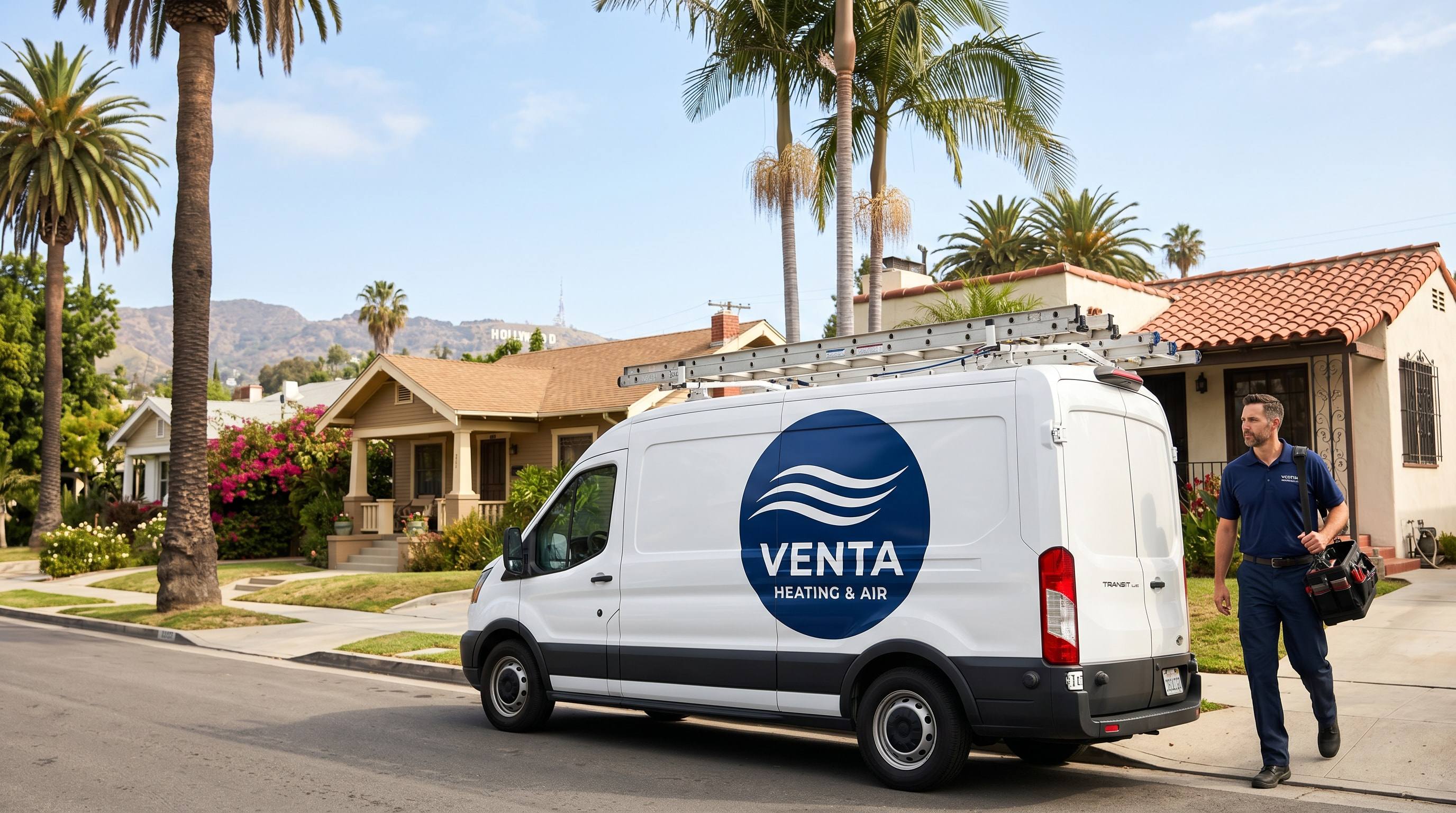
Roughly 60% of Malibu's residential housing stock predates 1975. Pre-Coastal-Act clapboard cottages along La Costa and Las Tunas, mid-century beach houses on Carbon and Broad, the 1950s and 60s wood-framed bluff homes on Point Dume, the original 1920s and 30s fishing-shack-era cottages still scattered through Big Rock and Surfrider. None of it was designed for central air. Most of it still doesn't have any. The era of the building is the single best predictor of what the right HVAC scope looks like here, and any contractor trying to sell you a ducted central system on a 1958 cottage with no chase routes is either uninformed or counting on you not knowing better.
The newer Malibu housing (ultra-luxury 1990s–2020s estates on Carbon Beach, Broad Beach, and the gated Point Dume Bay Club enclaves) runs the opposite direction: $5M to $50M+ properties with full ducted multi-zone systems, premium variable-speed equipment, and the additional baseline expectation that everything is coastal-spec from day one because the salt environment doesn't care about the price of the house.
What the construction era predicts about scope
- Pre-1975 cottages (La Costa, Las Tunas, Big Rock, Surfrider): typically no ductwork, often a wall heater or floor furnace as the only existing system. Mini-split heat pumps are nearly always the right answer. Single-zone $4,200–$6,800. Multi-zone whole-house $10,500–$15,500.
- 1975–2000 mid-tier residential (much of Malibu Park, Las Flores, the Civic Center area): ducted central systems already in place but typically uncoated equipment that's lost meaningful coil surface to salt. Replacement scope plus duct evaluation. $9,500–$14,500.
- Post-2000 ultra-luxury beach estates (Carbon, Broad, Point Dume Bay Club, Paradise Cove, Big Rock Mesa): premium variable-speed multi-zone with coastal-spec coils as baseline, smart-home integration, and HOA design review on outdoor equipment placement. $18,500–$45,000+ for full system replacements.
Salt corrosion is the dominant failure mode regardless of era
Within one mile of the surf (which is most of the city) salt aerosols land on aluminum fins and copper tubes year-round. Standard residential condensers lose 20–30% of expected service life here. We refuse to install non-coastal-spec equipment on ocean-side jobs. Equipment lines we install for Malibu by default: Rheem Seacoast, Carrier Performance Seacoast, Mitsubishi inverter (already coastal-rated), Daikin desert/coastal kit. Premium over baseline equipment runs $400–$900. We don't pretend a non-coated condenser will last on a Malibu install, and if a competitor quoted you uncoated equipment for an oceanfront property, that's the first question to ask them.
A January call from Carbon Beach worth the longer story
January 2026, a property on Carbon Beach. The owner had been out of state since November. Caretaker called us at 7:15 a.m. Tuesday because the indoor air smelled like wet concrete. We were on PCH heading west by 8, on site by 9:45 (Tuesday morning, no real traffic), and the diagnosis took fifteen minutes. The condenser drain line had backed up over the holidays, the air handler had been running through a partially submerged pan for at least six weeks, and the ductwork running under the bedroom wing was now growing the kind of mold colony that does not get cleaned, only removed.
The original install (from a different shop in 2019) had used uncoated coil and a builder-grade condensate trap with no overflow safety. Coil was 40% gone to chloride pitting. Trap had no float switch. We isolated the system, drained the air handler, swapped the trap with a properly sized P-trap and float switch ($340), and quoted a full equipment replacement plus a 30-foot duct section replacement for $24,800. The job ran in early January 2026, before the February 24 HEEHRA waitlist date and after the federal 25C December 31, 2025 expiration — so the $3,000 TECH standard tier was applied (last available reservation in this customer's case), but the $2,000 federal credit was already gone. Owner approved by phone that afternoon. We finished the job the following week with a coastal-spec Carrier Performance and a duct section that won't be growing mold the next time a snowbird leaves for the holidays.
The takeaway: the original install wasn't wrong; it was incomplete. Coastal-spec coil, condensate safety, and a maintenance schedule would have prevented the entire cascade. We tell that story to anyone considering a builder-grade install on an oceanfront property.
What wildfire smoke does to the IAQ scope
Malibu sits in the Woolsey Fire (2018) burn footprint, the Franklin Fire (2024) burn footprint, and the January 2025 Palisades Fire western edge. Wildfire-smoke season recurs annually between those events. Standard MERV-8 builder filters do roughly nothing for PM2.5 smoke particles. We retrofit MERV-13 (or MERV-16 if blower static allows) on standard installs and add whole-house HEPA bypass systems for clients with respiratory sensitivities, $1,400–$2,400 installed. Full preparedness guide: Wildfire Smoke and HVAC pillar. Detail: indoor air quality services.
HOA design review — we handle the packet
Point Dume Bay Club, Paradise Cove HOA, Big Rock Mesa Property Owners Association, Las Flores Heights, and several other Malibu-area HOAs have rules on outdoor equipment placement, screening, sightlines, and finishes. We pull the rules at quote time, spec compliant equipment (slim-profile coastal-spec inverter condensers run 55–62 dB and are easily screened), and submit the design-review packet on your behalf. Review can add 2–6 weeks to install timing depending on the district; we tell you that up front.
The snowbird and absentee-owner workflow
A meaningful share of Malibu property is second-home or seasonal rental. Owners are often out of state for months while equipment runs hard during peak rental season. Standard absentee-owner package, four touchpoints:
- Spring tune-up before you arrive (March or April).
- Mid-summer drive-by during peak run-time (typically late July).
- Fall tune-up after you leave (October or November), winterization of any unused mini-split heads.
- Priority emergency dispatch if anything fails while you're away; we coordinate with your property manager or housekeeper.
$295/year for the 2-visit + drive-by plan. Optional add: smart-thermostat remote monitoring with anomaly alerts. Detail: maintenance plans.
When we can't get there same-day
Pacific Coast Highway is the one road in and the one road out, and we're honest about what that means. Saturday and holiday-weekend mornings can stretch our 90-minute Westside dispatch to 3+ hours. We can't get same-day during heat waves when every truck is already running calls in West LA. PCH closures from rockslides, fire, or accidents occasionally force re-routing through Topanga or Mulholland Highway, which adds another 45–60 minutes. We schedule first-of-day arrivals (7–8 a.m. before traffic builds) for Malibu jobs whenever possible, and the dispatcher gives you a real ETA at booking instead of a promise we can't keep.
Coverage
Carbon Beach, Broad Beach, Paradise Cove, Point Dume, Zuma, La Costa Beach, Big Rock, Las Tunas, Surfrider, the Civic Center area, Las Flores Heights, Malibu Park, the Topanga and Las Virgenes corridors. Beyond city limits: Santa Monica, Pacific Palisades, Topanga, Calabasas, and out toward Woodland Hills.
(424) 766-1020 reaches a real person on the West LA dispatch line. CSLB #1138898 (C-20). Fully insured. TECH Clean California registered contractor.