
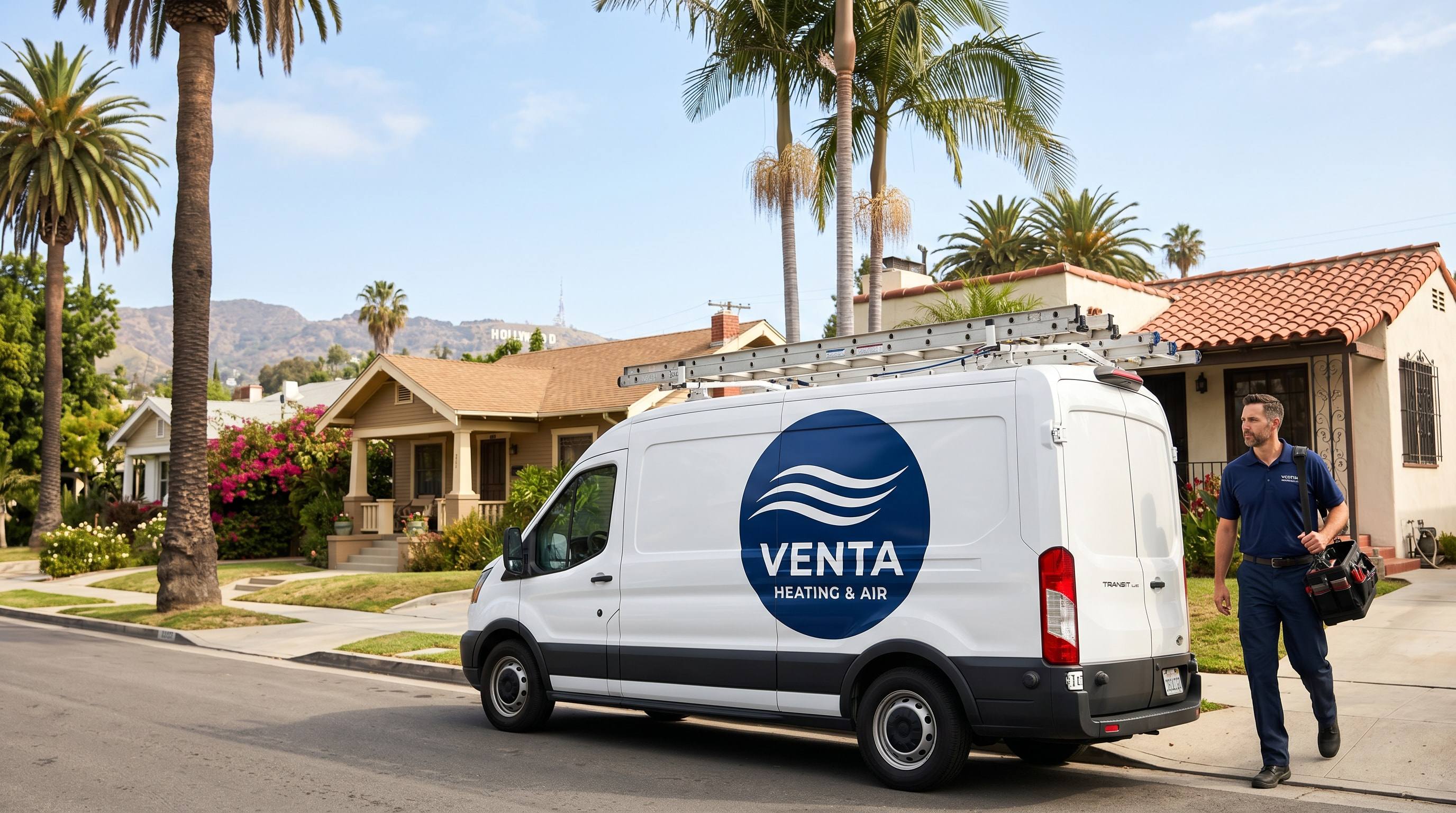
How do you replace the AC in a 1958 post-and-beam Mid-Century with no attic, an exposed-beam vaulted ceiling, and the original ductwork buried in floor chases nobody can reach? That's a real Brentwood Glen question, and we get some version of it every couple of weeks. The answer changes based on what's actually behind those soffits, which is why we won't quote one of these jobs without putting a tech on site for an hour first.
That's the kind of work Brentwood is. A 7,500 sq ft estate on Mandeville Canyon Road with a guard gate and a designer who has opinions about visible condensers. A 1928 Spanish revival south of Sunset where the existing ducts are 60% leaking. A 2018 contemporary in the Country Estates with a 24-foot vaulted entry, west-facing glass, and a Carrier Infinity 26 board that's throwing a comm fault every Thursday afternoon. The market is residential, mostly premium, mostly architecturally interesting, and almost never a like-for-like swap.
The hardest design problem in Westside HVAC
Brentwood Glen and Crestwood Hills got built out 1948–1968 in the post-and-beam Mid-Century vernacular — intentionally no attic, exposed structural beams, soffit-routed ductwork. That was elegant in 1958. In 2026 it means the original galvanized ducts are 65 years old, the cloth-tape sealing aged out around year 30, HERS leakage testing routinely shows 35–50% loss, and there's no easy way to replace any of it without tearing into the architectural language of the home.
Three real options, each with trade-offs we'll walk you through:
- Keep-and-seal. Replace the outdoor and indoor units, leave the existing ductwork in place, do a thorough leakage test, and seal whatever sections we can access. Works when the ductwork is salvageable. Cheapest of the three. Doesn't fix everything.
- Go fully ductless. Abandon the ducted system, install a multi-zone Mitsubishi MXZ or Daikin VRV with concealed-cassette indoor heads or wall-mounted units with line-hide trim that respects the architectural lines. Works on most layouts and bypasses the ceiling entirely. Highest aesthetic preservation. Most expensive.
- Hybrid. Keep the ducts for main living spaces where they're still healthy, add ductless heads to the bedroom wing where access is worst. Common middle path.
What estate-scale Manual J actually looks like
A 5,500–9,000 sq ft hillside home doesn't have one cooling load. It has eight or ten, each with its own orientation, glazing, ceiling height, and use pattern. We measure the home zone by zone — the east-facing primary suite that catches morning sun, the lower-level media room with 4 kW of AV equipment, the wine cellar that wants 55°F continuously, the pool house cabana that runs on its own thermostat. The right design splits the property into two, three, or four independent zones with appropriately sized variable-speed equipment serving each, and stages the system so any one component failure leaves the rest of the house running.
Equipment selection on premium-tier quotes
We're factory-certified on Carrier Infinity, Lennox Signature, Mitsubishi multi-zone, Trane XV variable-capacity, and Daikin Fit DZ20VC. We don't push one brand on every quote because the right product for a 1958 post-and-beam isn't the right product for a 2018 contemporary in the Country Estates.
Rough decision matrix, from a working contractor's perspective:
- Carrier Infinity 26 with Greenspeed Intelligence, best installed-cost-vs-efficiency on a fully ducted layout. Communicating thermostat ecosystem is mature. Dealer service network deepest in West LA.
- Lennox Signature SL28XCV, highest stated SEER2 (28+ at part load). Exceptional sound performance. Premium price.
- Mitsubishi MXZ multi-zone: the right call when ductwork access is constrained, which is most canyon hillside homes off Mandeville and Kenter where pulling new supply trunks is impractical.
- Trane XV20i / Daikin Fit DZ20VC, reliable middle-of-the-premium-tier when the household has existing brand familiarity.
Country Estates, gate guards, and access logistics
The Country Estates, the Crest, parts of Mandeville Canyon, and several of the Riviera-area enclaves all require advance security clearance for service vehicles. License plate, technician name, sometimes background-check documentation 24–48 hours ahead of the appointment. We handle that on every booking, and we coordinate gate-guard arrival times to the minute on properties with specific access windows. Discreet vehicles (unmarked or low-branded) available on request.
A working note for clients on the gated streets: mention the security requirements on the first call. It saves a same-day from getting bumped to next-day because the documentation didn't clear.
Discreet service is part of the scope
A meaningful share of Brentwood residents have privacy and security needs that shape how the work has to happen. Plain uniforms, photo ID on every tech, no photography of the home, no posting of addresses to review platforms. Confidentiality language is available in writing for sensitive accounts. We work with estate managers, household staff, security teams, interior designers, and GCs in the middle of remodels.
2026 rebate stack for Brentwood estate-scale installs
Brentwood is in LADWP territory (City of LA), and the LADWP heat pump rebate ($1,250 per ton ducted, $1,500–$2,500 per ton ductless) is the largest active 2026 incentive in the LA market. On multi-condenser estate installs (which is most of our local work), the LADWP rebate stacks across each qualifying outdoor unit — a 4-condenser layout serving a 7,000 sq ft hillside home can pull $20,000–$40,000 from LADWP alone. SoCalGas furnace-removal incentives stack on top when capping the gas line. TECH Clean California ($3,000 standard, up to $8,000 low-income) is currently waitlisted on single-family heat pump HVAC (funds fully reserved November 14, 2025) — we submit reservations on every qualifying install in case funding reopens. Federal IRA Section 25C ($2,000 heat-pump credit) was terminated December 31, 2025 under OBBBA and is no longer in the 2026 stack. On a typical $35,000–$60,000 multi-zone install here, the active utility stack commonly comes back $8,000–$25,000 depending on configuration. Full breakdown: verified 2026 rebate guide for Brentwood.
We're a registered TECH contractor — the rebate paperwork is filed for you, the rebate is paid to us, and we deduct it from your invoice. You don't chase reimbursement.
Coverage
Brentwood Park, Brentwood Circle, Brentwood Glen, Crestwood Hills, the Country Estates, the Crest, Mandeville Canyon, Kenter Canyon, the San Vicente flats, the Sunset corridor, and the Barrington commercial district. Beyond city: Pacific Palisades, Bel-Air, Westwood, Santa Monica. Neighbor pages: Santa Monica, Beverly Hills, West Hollywood, Culver City.
(424) 766-1020 reaches our West LA dispatch line. Real person picks up. Upfront pricing in writing. CSLB #1138898 (C-20).