
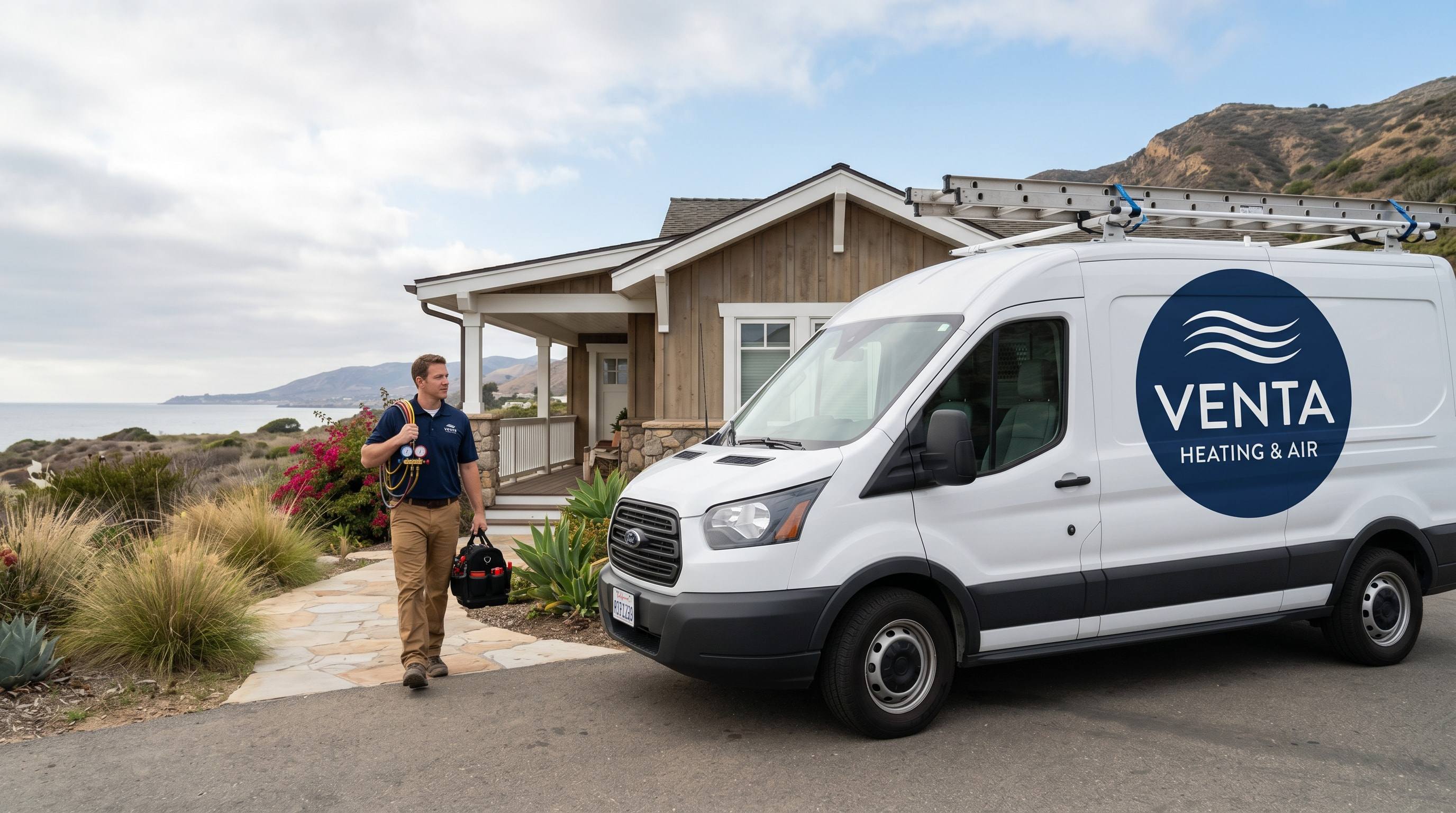
A note on routing before the rest: Calabasas is administratively in LA County, but our closest dispatch base is Thousand Oaks. From there it’s 12–15 minutes down the 101 versus an hour fighting Sepulveda Pass from any West LA point. So our Calabasas work runs through the Ventura County crew and the (805) 977-9940 line, even though you’re in 91301 or 91302. Same trucks, same techs, faster arrival. The page lives at the URL the dispatch route says it should.
With routing settled: Calabasas is one of the more demanding HVAC markets in Southern California, and not in the way most contractors assume. The premium is real, but it’s not about gold-plated equipment for its own sake. It’s about custom-home HVAC engineering done right, multi-zone systems designed to actually deliver the airflow each room needs, IAQ retrofits in a wildfire-prone canyon corridor, and execution that respects strict HOA approval processes and reasonable expectations of professional confidentiality. We do that work routinely.
Why HVAC in Calabasas is different
Three things stack to make Calabasas a distinct market. First, the climate: the hillside and canyon influence pushes summer afternoons routinely into the 95–105°F range, hotter than anywhere along the OC coast and harder on equipment than the mild Conejo Valley climate just over the hill. Cooling load is real and persistent from June through October. Santa Ana wind events compound the heat with debris ingestion that fouls outdoor coils faster than typical.
Second, the housing stock. Calabasas is dominated by custom luxury homes from 3,500 to over 10,000 sq ft, often in gated communities (The Oaks, Mountain View Estates, the Hidden Hills border), almost universally with pools, frequently with detached guest houses, pool houses, and multi-generational layouts that demand individual room temperature control rather than a single central thermostat. Standard residential split systems often don’t fit the airflow design these homes need. Multi-zone VRF/VRV systems are common, and they’re a different service profile.
Third, wildfire exposure. The Woolsey Fire in November 2018 burned through neighborhoods immediately south of the 101 and destroyed homes in Malibu, Agoura, and the unincorporated canyon areas adjacent to Calabasas. The cumulative regional fire impact (Woolsey, the 2017 Thomas Fire, multiple smaller incidents since) has elevated PM2.5 baselines across the area, and IAQ work is now part of standard practice here, not an upsell.
Common HVAC issues we see in Calabasas
- VRF branch-box failures and refrigerant imbalance. Mitsubishi City Multi and Daikin VRV systems require periodic refrigerant rebalancing and branch-box service. When something fails, a residential HVAC tech without VRF training will misdiagnose it; we don’t.
- Coil fouling from Santa Ana debris. Hillside condensers downwind of canyon vegetation pull leaves, eucalyptus debris, and ash directly into the coil fins. Annual coil rinse is genuinely necessary in this market, not optional.
- Post-fire IAQ remediation. Even homes that didn’t burn in 2018 have measurable particulate residue in supply ducts. We do filter-swap, coil-rinse, and blower-wheel cleaning protocols after any major regional event.
- Oversized residential split systems on custom homes. Some 1990s and early-2000s Calabasas custom homes were built with multiple residential split systems instead of zoned VRF, and they short-cycle, run uneven temperatures across rooms, and waste energy. Replacement-decision math often favors converting to a single VRF system at the next change-out.
- Pool-house and guest-house mini-splits failing in isolation. Detached structures often run on a single Mitsubishi MSZ-FS or Daikin Quaternity head that ages out independently of the main-house system. We service these as a regular part of Calabasas work.
- HOA architectural review delays. A condenser change-out you could do in two days in an ungated community takes 3–6 weeks in The Oaks once you account for HOA submission, review, and approval. We prep the packet and submit on your behalf.
Equipment recommendations for Calabasas
The default equipment specification is genuinely different from family-home suburbs. Our common quoted lineup:
- Mitsubishi City Multi VRF for whole-home zoned systems on 4,500+ sq ft custom homes. Multiple outdoor units feeding 8–14 indoor heads (ducted concealed, wall-mount, or ceiling cassette). Individual room temperature control with central or distributed thermostats.
- Daikin VRV Aurora or VRV Life as alternative VRF systems with strong heat-pump performance and tighter integration with home automation. Comparable engineering and pricing to Mitsubishi City Multi.
- Carrier Infinity 26 or Lennox SL28XCV variable-speed inverter splits where standard residential equipment is the right answer (smaller homes, simpler floor plans, owner-stated preference). 26 SEER2 with two-stage humidity control.
- Mitsubishi MSZ-FH and Daikin Quaternity for guest houses, pool houses, and detached ADUs. Single-zone ductless with serious efficiency and quiet operation under 30 dB at low fan speeds.
- MERV 13 retrofit cabinets, whole-house bypass HEPA, and balanced ERV fresh-air systems for IAQ-sensitive families. The post-Woolsey baseline.
Honest opinion: Calabasas custom homes warrant the three-step Manual J + Manual D + Manual S design process (load calculation, duct design, equipment selection), not standard rule-of-thumb sizing off square footage. A 6,000 sq ft custom home with vaulted ceilings, walls of glass, and a southwest exposure can need anywhere from 6 to 10 tons of cooling depending on construction and orientation; getting it wrong by a ton in either direction means short-cycling humidity problems or insufficient cooling on 100°F afternoons. We do the calculation properly and the design follows from it. Service backstops: AC installation and heat pump installation.
Real-world composite example
6,800 sq ft Calabasas custom home in The Oaks, built mid-2000s. Existing system: 15-year-old VRF setup running parallel to dual gas furnaces serving the main house and detached pool/guest house. Owner’s goal was full electrification ahead of long-term ownership, with improved IAQ for a household member with respiratory sensitivity. Scope after Manual J + D + S design: Mitsubishi City Multi VRF system, 4 outdoor units feeding 12 indoor zones, paired with cold-climate heat-pump backup for the rare overnight low-30s mornings, MERV 13 retrofit cabinet on the central return, whole-house bypass HEPA, balanced ERV, and post-Woolsey duct sanitation as part of the changeover. Total project: $89,500 installed. Three-week timeline coordinated with the homeowner’s general contractor on adjacent interior work, HOA approval secured in week one. SCE rebates applied where eligible. Federal Section 25C credit no longer available (expired December 31, 2025), and we said so up front in the proposal so the owner wasn’t banking on math that doesn’t exist anymore.
Service area within Calabasas
We cover Calabasas comprehensively: The Oaks, Mountain View Estates, the Hidden Hills border streets, Calabasas Park, Mulholland Heights, Saratoga Hills, the older Calabasas core south of Mulholland, and the canyon-adjacent properties on Old Topanga Canyon. Same-day response across 91301 and 91302 during business hours from Thousand Oaks dispatch, with 30–50 minute typical arrival depending on 101 conditions. Beyond Calabasas, the same crew runs Hidden Hills, Agoura Hills, Westlake Village, Thousand Oaks, and Oak Park. Wider county view: Ventura County HVAC.
Gate-clearance protocol: when you call, tell the dispatcher which gated community you’re in. We coordinate the entry list with your gatehouse so the truck doesn’t sit at the gate for 20 minutes burning your dispatch window. Standard practice in The Oaks and Hidden Hills.
Why Calabasas homeowners choose Venta
Six things, plainly. We have actual VRF/VRV training and service capability on Mitsubishi City Multi, Daikin VRV, and LG Multi V product lines, not just residential split. We use Manual J + D + S three-step engineering on custom homes rather than rule-of-thumb sizing. We prep and submit HOA architectural review packets (cut sheets, dB ratings, dimensions, site-plan markup, screening details) as part of every install quote. We work with professional confidentiality on celebrity and high-profile homes, NDAs available on request, unmarked vehicles available on request. We handle post-Woolsey IAQ retrofits and post-event smoke remediation as standard practice. And we file SCE and SoCalGas rebate paperwork on every qualifying install at no charge to you, with verified 2026 status (federal Section 25C expired, TECH waitlisted): 2026 rebate guide.
Phones at (805) 977-9940 are answered 24/7 by a live human. Field dispatch runs 8 AM–8 PM. Diagnostic fee is $89 standard, $149 after-hours, applied to the repair if you proceed. CSLB #1138898 (C-20).