
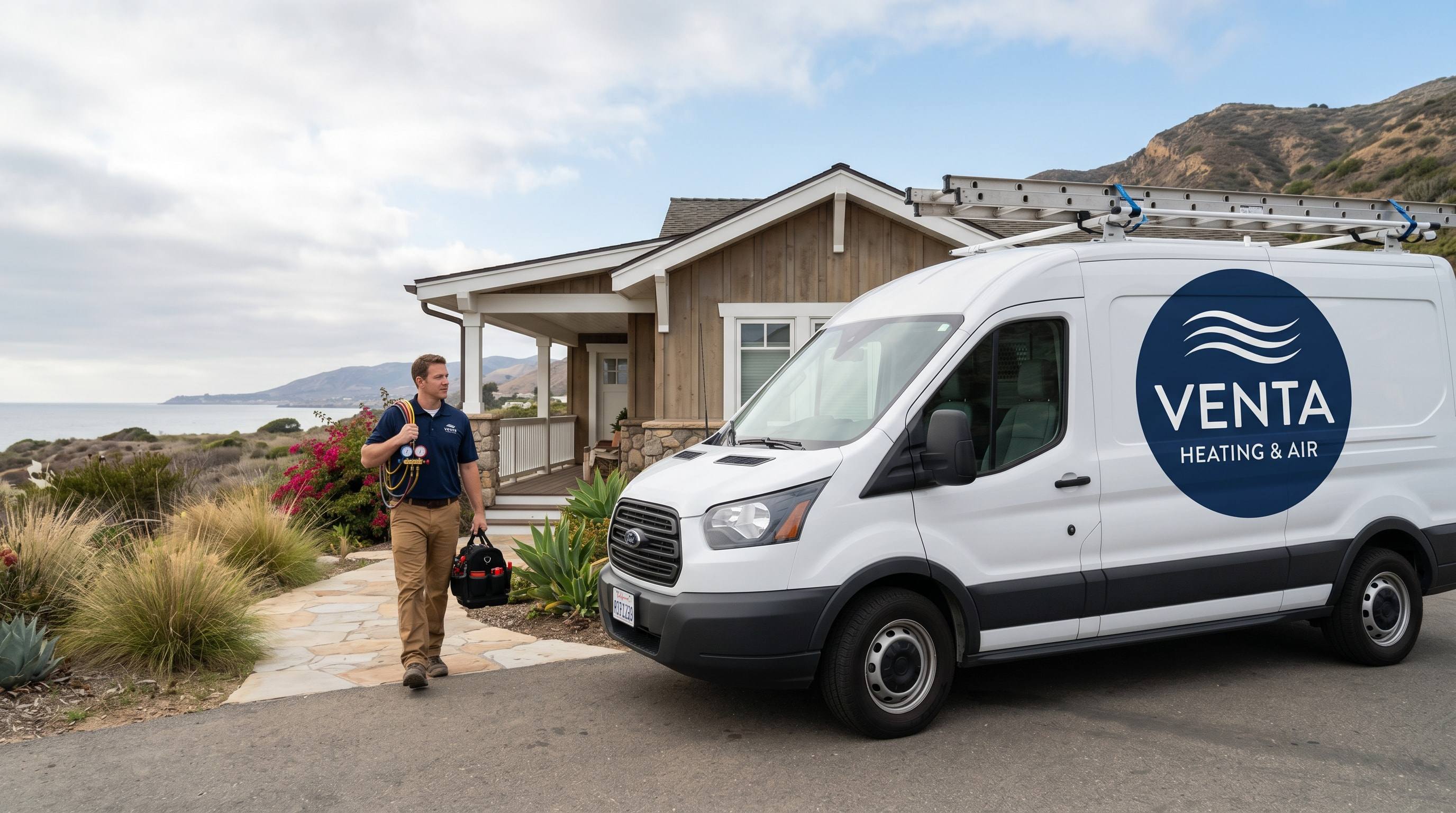
How do you put air conditioning into a 1923 Craftsman bungalow on Cedar Street without tearing up the original plaster, the picture-rail trim, or the built-in window seat?
You don’t. You skip the ductwork question entirely. The standard solution we install in pre-1940 Midtown and the historic Pierpont blocks is a mini-split heat pump, slim outdoor condenser placed at the rear of the property (out of street view, often coordinated through the Historic Preservation Commission so it stays hidden), a 3-inch refrigerant line through one wall penetration, and 1–4 indoor heads mounted high on interior walls. No soffit drops, no plaster damage, no impact on the original built-ins or trim. Single-zone runs $4,200–$6,800. A whole-house 3-zone system, $9,500–$14,500. The mechanical work is fast, the historic interior stays exactly as it is, and the house gets year-round comfort it was never designed for.
That’s most of the historic-Ventura HVAC story. The harbor and salt-air story is the other half.
How fast does salt actually destroy a standard condenser?
Faster than the manufacturer’s warranty. The Ventura Harbor, the Pierpont peninsula, and the beachfront blocks from Marina Park through Solimar are some of the most aggressive salt-air environments anywhere in Southern California. Standard residential condensers placed within a mile of the surf show a predictable failure timeline:
- Year 1: minor surface oxidation on aluminum fins, no measurable performance impact.
- Year 2–3: visible fin pitting, slight reduction in heat-transfer area, electrical contacts dulling.
- Year 4–5: contactor coil pitting causing intermittent compressor starts, capacitor leakage current rising, fan-motor bearings beginning to seize.
- Year 7–10: outright failure. Coil leaks at brazed joints, fan-motor seizure, contactor welding.
The fix is equipment selection at install. We default-spec coastal-rated equipment (e-coated coils, polymer-coated cabinets, stainless hardware) west of Highway 33 / Telephone Road, and we recommend it for any property within a mile of the Pacific. Premium runs $400–$700 over standard equipment and pays for itself the first time you avoid an early replacement.
Why don’t Ventura summers actually feel that hot?
Because they aren’t, on the coast. Coastal Ventura summer afternoons rarely exceed 78–82°F, and the marine layer keeps mornings overcast through most of July and August. Sensible cooling load is small. What matters is humidity. Morning relative humidity routinely sits at 80–95%, and an oversized single-stage AC short-cycles before it can dehumidify, leaving the house feeling clammy at a 72°F setpoint and the homeowner wondering why the new equipment doesn’t feel like it’s working.
We deliberately undersize relative to inland-VC rules of thumb. Variable-speed equipment that can run long dehumidification cycles at 30–50% capacity does the actual job here. This is a chronic miss-spec from contractors used to inland sizing.
Where does Ventura get genuinely warm?
East of the 101, in the foothill blocks toward Ojai, in the upper Ondulando and Hillside neighborhoods. Properties there see 85–90°F afternoons and a more conventional cooling load profile. Manual J for those homes looks closer to Camarillo than to the harbor.
What about the short-term rental wear pattern?
Properties near the historic district, the harbor, and the beach run as Airbnb and other short-term rentals at meaningfully higher occupancy than typical residential. Continuous-load operation wears builder-grade single-stage equipment out in 5–7 years instead of 12–15. Variable-speed condensers paired with smart-thermostat lockouts (preventing guests from setting the system to 65°F overnight) is the right spec for these properties. We’ve installed this combination on dozens of Pierpont and downtown rentals.
What about the rebate stack?
Ventura’s mild year-round climate makes it one of the best California cities for heat-pump conversion: small heating load, moderate cooling load, modest-capacity equipment covers both. The standard-income TECH Clean tier has no income cap.
- SCE: heat-pump and smart-thermostat incentives ($300–$1,200). Active.
- SoCalGas: furnace-removal incentive when capping the gas line. Active.
- TECH Clean California: $3,000 standard / $4,000 moderate (80–150% AMI) / up to $8,000 low-income (<80% AMI) when funded. Status as of May 2026: single-family heat pump HVAC funds fully reserved November 14, 2025; HEEHRA fully reserved February 24, 2026. New reservations go on a waitlist; we submit on every qualifying install.
- Federal IRA Section 25C: terminated December 31, 2025 under OBBBA. No longer available for 2026 installs.
Worked 2026 example: $9,200 quoted on a 3-ton variable-speed coastal-rated heat pump replacing a 14-year-old gas furnace plus corroded condenser. SCE $400. SoCalGas $300. Active-stack net: $8,500. If TECH funding reopens during the project window, the $3,000 standard tier deducts on top, dropping net to $5,500. Detail: TECH Clean California rebates and the verified 2026 rebate guide.
What we cover
- AC repair: coastal-rated parts inventory.
- AC installation, sized for marine latent load.
- Mini-split installation — the standard answer for pre-1940 Midtown and Pierpont.
- Heat-pump installation with full TECH rebate filing.
- Furnace service.
- Historic Preservation Commission coordination on visible exterior work.
- Indoor air quality and duct cleaning — humidity and salt-air specialty.
- 24/7 emergency dispatch.
Coverage: Ventura proper plus Oxnard, Camarillo, Ojai, and the unincorporated coastal areas. Wider county view: Ventura County HVAC. CSLB #1138898 (C-20). Permits and HERS in your name.