
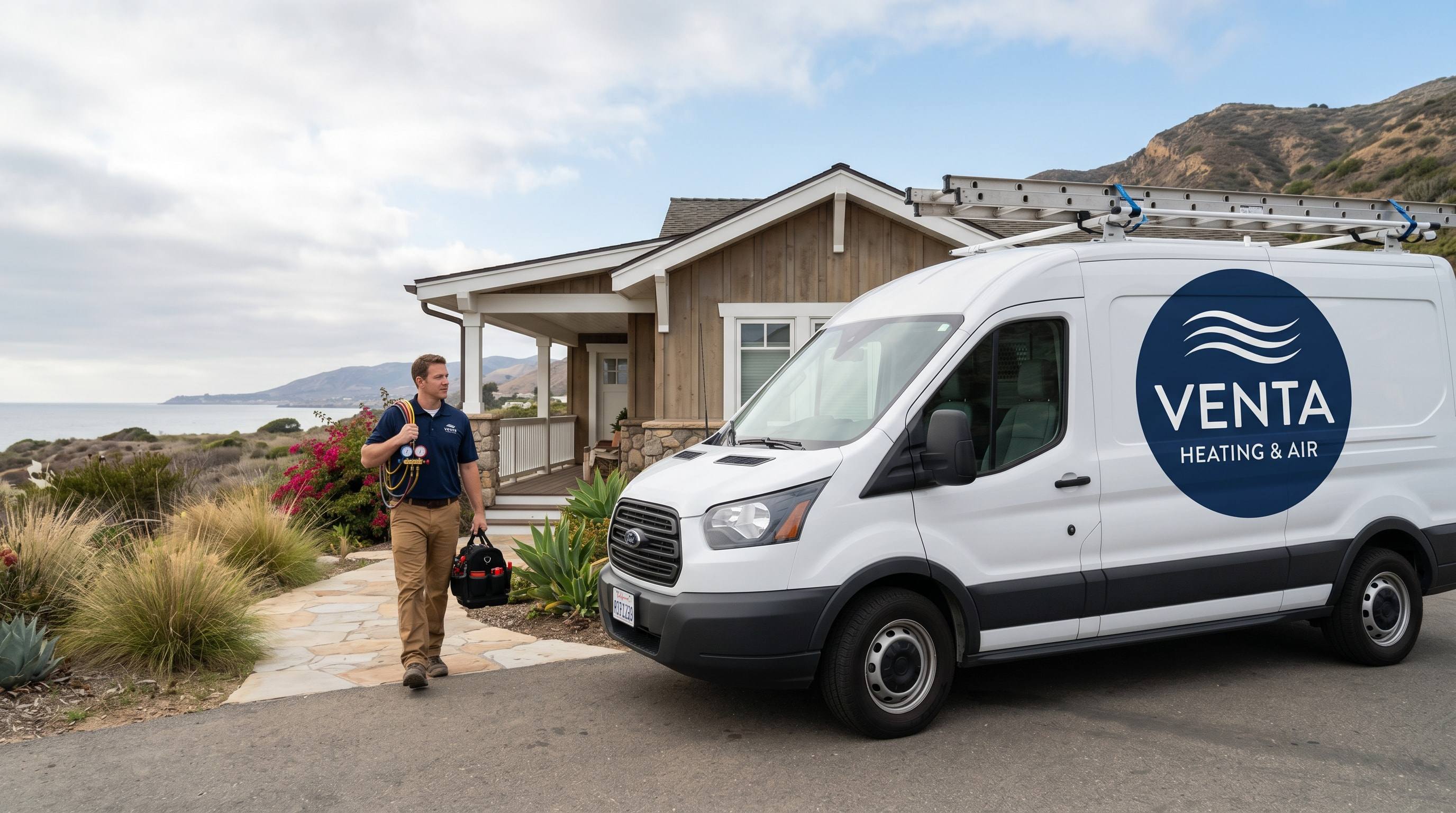
Westlake Village is not a coastal city, even though half the people who quote it treat it like one. You sit inland in the Conejo Valley behind the Santa Monica Mountains, with afternoon temperatures that routinely run 92–100°F July through September and Santa Ana wind events in fall that drive emergency service calls more than any other single weather pattern in our Ventura County route. Your homes are bigger than coastal-OC tract average (3,000–5,000+ sq ft is normal here), most of them are dual-system, and almost all of them are inside HOAs that take architectural review seriously. The contractor who quotes you in 30 minutes off a phone call is missing every one of those constraints.
Why HVAC in Westlake Village is different
Four things shape every install we do here. First, the Conejo Valley climate. You’re inland enough that cooling load is real and multi-day heat domes push past 100°F several times each summer; the 2017 and 2024 heat events both put the Conejo Valley in the regional news. Sized off a coastal rule of thumb, AC here runs short by 25–30% on the August afternoons that actually matter.
Second, Santa Ana wind season. The Santa Ana wind corridor runs right through the Conejo Valley and ridge-side Westlake homes (Three Springs, Westlake Island, the upper streets in The Oaks) catch it harder than anything in our service area outside the SGV foothills. Coil fouling from debris ingestion accelerates equipment wear; we see capacitor and contactor calls cluster after every major event.
Third, the housing stock. Westlake Village was built mostly between the early 1980s and the early 2000s as a master-planned community. Larger lots, larger homes, gated where the original developer intended gated, with HOA architectural review boards that have meaningful authority over outdoor equipment placement, screening, and noise. First Neighborhood, The Oaks, North Ranch (straddling the Westlake / Thousand Oaks line), Three Springs, Westlake Trails, Westlake Island, Westlake Pointe — each one has its own specs.
Fourth, dual systems. Most homes in this size range run two HVAC systems (upstairs / downstairs split) rather than a single oversized one. That changes the replacement math and the project sequencing in ways most contractors don’t price.
Common HVAC issues we see in Westlake Village
- One of two systems failing while the other is healthy. The most common dual-system call. Owners ask whether to replace both at once or stagger; we run the diagnostic on both and give honest math both ways.
- Post-Santa-Ana coil fouling and reduced cooling capacity. Debris in the outdoor coil chokes airflow, refrigerant pressures climb, compressor runs hotter and shorter cycles. Coil rinse and capacitor check usually restore capacity; left alone, it ages the compressor 2–3 years in a season.
- HOA-noncompliant equipment from prior contractors. Equipment installed without architectural review, then flagged at sale or by a neighbor complaint. We’ve been called in to relocate or re-screen units that should have gone through the original submission.
- Builder-grade single-stage outdoor units running at full capacity through August. 90%+ of the original 1980s and 1990s installs were single-stage; those compressors live a hard life under Conejo Valley summer load and most are at or past first replacement age.
- Undersized AC on additions and remodels. Many Westlake homes have had additions over the years (sunroom conversions, primary suite expansions, pool houses) without an HVAC re-sizing. The result is one zone that never quite cools.
Equipment recommendations for Westlake Village
For Westlake Village specifically, the equipment story tilts to variable-speed for two converging reasons: HOA noise specs prefer it, and the larger homes here actually use the modulation. Three setups we install most:
- Trane XV20i variable-speed heat pump (4 or 5 ton) with matched TAM9 air handler. The quietest in class at low-load run, which is what HOAs in The Oaks and Three Springs care about. Eligible for active SCE rebates. Installed runs $15,500–$18,800 single-system 4-ton; $30,000–$36,000 on a matched dual-system replacement (4-ton + 4-ton or 4-ton + 3-ton).
- Carrier Infinity 25VNA8 variable-speed with matched FE5 air handler. Equivalent comfort tier with Carrier’s Greenspeed inverter logic and 10-year parts warranty. Slight edge for owners who want the Carrier control platform integration with Ecobee or comparable smart thermostats. Installed $15,200–$18,400 single-system 4-ton.
- Lennox SL25XCV variable-speed as the third major-brand option. Lennox iComfort control platform, premium-tier corrosion handling. $15,400–$18,500 installed on a 4-ton replacement.
For owners who want to step down from variable-speed (cash-flow constraint, shorter remaining ownership horizon), a two-stage Trane XR16 or Carrier Performance 17 lands $11,500–$13,800 on a 4-ton, with quieter low-load operation than single-stage but without the variable modulation. Detail on full installation scope: AC installation service page.
A real Westlake Village example
Recent project: 4,500 sq ft Westlake Village home in The Oaks, dual HVAC (upstairs and downstairs), 13-year-old Carrier systems both reaching end of life. Diagnostic found the downstairs unit had a leaking evaporator coil with refrigerant charge 22% low; the upstairs unit had a failed start capacitor and a contactor showing arc pitting consistent with another 6–12 months of remaining life. Owner wanted to address both at once rather than stagger, and the HOA review board (The Oaks) requires submission for any equipment change.
HOA-approved replacement: dual Trane XV20i 4-ton variable-speed heat pumps with matched TAM9 air handlers, total $32,500 installed, including permits, HERS verification on both systems, HOA submission packet, removal of both old units, and gas-line capping with a SoCalGas furnace-removal incentive filed. SCE territory; we filed the active 2026 SCE rebate stack. TECH waitlisted at the time of install. Project completed within 4 days including HOA equipment approval; the board turned the submission in 48 hours because the equipment matched existing aesthetic guidelines and the dB rating came in under the community spec.
Service area within Westlake Village and beyond
Our Conejo Valley route from Thousand Oaks reaches every Westlake Village community: The Oaks, North Ranch, First Neighborhood, Three Springs, Westlake Trails, Westlake Island, Westlake Pointe, the Westlake Hills blocks, and the gated streets above Westlake Boulevard. Coverage extends to Agoura Hills, Oak Park, Newbury Park, Calabasas, and the Westlake-bordering portions of Hidden Hills with comparable response times. Wider county view: Ventura County HVAC.
Why Westlake Village homeowners choose Venta
HOA submission handled by us, not by you. We work with HOA approval processes routinely and the packet is part of the install quote, not an afterthought. Manual J load calc on every install, sized for the actual Conejo Valley peak design temperature instead of the season average. Dual-system experience on larger Westlake homes, with honest math on stagger-vs-replace-together. Santa Ana wind preparation in late September with pre-event coil rinse and capacitor check. $89 standard diagnostic with a written fixed-price quote, $149 after-hours. Permits pulled in your name, HERS verification scheduled by us, rebate paperwork filed for you. CSLB #1138898 (C-20). Phones stay live around the clock; field dispatch runs 8 AM–8 PM with on-call for genuine emergencies.